
Webhooks look like the easiest thing in the world. You send an HTTP POST to a URL. Job done.
Your payment system notifies your inventory system. Your CI/CD pipeline pings Slack. Your CRM gets updated in real-time. What’s the big deal?
The big deal is that under the hood, every production-grade webhook system is a series of desperate hacks duct-taped together. Retry with exponential backoff. Payload signing. Idempotency keys. Limitless logging to figure out which events silently disappeared. As one experienced developer summarized it on a popular architecture forum: webhooks cannot be the only delivery mechanism, you always need some kind of query/sync mechanism to reconcile the gaps.
This isn’t an accident. It’s a feature of choosing an HTTP push model for what is fundamentally a messaging problem. And a growing minority of architecture teams are asking the heretical question: what if we stopped pretending webhooks are simple and just used a proper messaging protocol instead?
The Webhook Promise Is a Lie
Let’s be honest about what webhooks actually deliver. The marketing says “instant, efficient event notifications.” The reality is closer to “best-effort shouting into the void.”
The core problems are structural, not cosmetic.
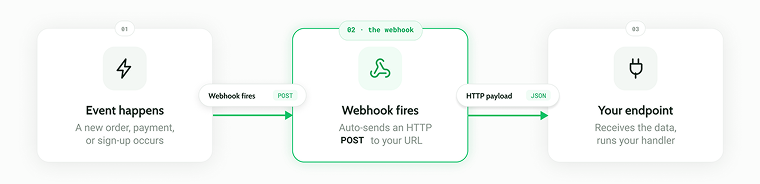
No delivery guarantee. Sanity, a modern CMS with an otherwise excellent architecture, is explicit about this: webhooks come with no strict delivery guarantee. Two retries at 30-second intervals, and then the event simply vanishes. The recommended workaround? Periodically reconcile against the source of truth. In other words, poll the API for changes anyway, the very thing webhooks were supposed to eliminate.
Single-concurrency bottlenecks. Most webhook providers serialize delivery. A slow handler blocks the queue. Your 30-second timeout becomes a hard ceiling, and if your handler takes 31 seconds, the event is gone. The conventional wisdom says “acknowledge fast and process asynchronously”, but that shifts complexity into your codebase where it becomes your problem to manage.
Duplicate deliveries are guaranteed. Retries mean the same event arrives more than once. Providers include idempotency keys, but the burden of deduplication falls entirely on the consumer. As the Reddit thread on this exact topic highlighted, “at-least-once delivery means duplicates will happen”, and handling them correctly requires the Idempotent Consumer pattern, which is one of 22 microservice patterns most developers only learn after a production incident.
Authentication is bolted on. A webhook endpoint is a public URL. Providers sign payloads with secrets, but verification adds friction. The Sanity webhook documentation warns that verifying against a parsed JSON body instead of the raw bytes will cause the signature check to silently fail. Framework auto-parsing breaks your security. This is the level of operational hygiene we’ve normalized.
What AMQP 1.0 Actually Gives You
AMQP 1.0 isn’t new, it’s an OASIS standard that’s been production-hardened for over a decade. But it’s having a moment as architects look for alternatives to the webhook treadmill.
The architectural insight that drives this shift is straightforward: webhooks are trying to solve a messaging problem using HTTP’s request-response model. The result is a protocol mismatch that requires layers of ceremony to patch.
AMQP 1.0 sidesteps these issues by design. A message broker sits between producers and consumers. The producer publishes a message and moves on. The broker owns delivery, including persistence, routing, and acknowledgment. The consumer receives the message when it’s ready, not when the producer decides to fire a request.
One Reddit user who implemented AMQP 1.0 for their large retail platform described the result succinctly: “It works really well… once in place all our customer are happy about it.” The catch? “The one thing that gets a bit tiring is the resistance most people have against connecting with an AMQP broker.”
That resistance comes from two places: unfamiliarity and the operational overhead of running a broker. But for teams that have crossed that threshold, the benefits are substantial.
Reliability That Isn’t Negotiable
AMQP 1.0 supports three delivery guarantees out of the box:
| Mode | Behavior | Use Case |
|---|---|---|
| At-most-once | Message delivered zero or one times | High-throughput telemetry, non-critical logs |
| At-least-once | Message delivered one or more times | Default for most business events |
| Exactly-once | Message delivered exactly one time (requires broker and consumer coordination) | Financial transactions, critical state changes |
Compare this to webhooks, where your guarantee is essentially “we’ll try a few times and then give up.”
The broker also handles backpressure automatically. If consumers are slow, messages queue on the broker. No dropped events. No cascading failures from retry storms. The broker acts as a shock absorber.
Security That Isn’t an Afterthought
Unlike webhooks, which require each endpoint to implement signature verification individually, AMQP 1.0 supports TLS encryption, SASL authentication, and claims-based security at the protocol level. The transport is authenticated and encrypted before any application data flows.
For enterprise teams, this alone can be the deciding factor. HTTPS endpoints raise questions from security teams, questions about exposure, port management, and monitoring. AMQP over a private network with managed authentication doesn’t trigger the same alarms.
Decoupling That Actually Works
The most significant architectural benefit is temporal decoupling. With webhooks, the producer and consumer are coupled in time: if the consumer is down, the event is lost. With a broker, the consumer can be offline for maintenance, experience a spike in latency, or get replaced entirely, and the producer never knows.
This matters more than most teams realize. A production incident on the consumer side doesn’t become an emergency on the producer side. The broker absorbs the shock.
The Real Objections (And Why They’re Overblown)
The most common pushback against AMQP 1.0 adoption is that “everyone can implement a webhook.” This is true. It’s also true that everyone can write a basic todo app. Production-grade systems are different.
The Hookdeck guide on Sanity webhooks lists four pain points that are, in practice, mandatory to handle for any serious integration: no delivery guarantee, single-concurrency delivery, signature verification complexity, and duplicate deliveries. Each of these requires infrastructure or code. Each is solved by a standard messaging protocol.
The second objection is operational complexity. Running a broker requires infrastructure. But this argument has weakened considerably. Managed services like Amazon MQ, Azure Service Bus, and Google Cloud Pub/Sub offer AMQP 1.0 compatibility with zero infrastructure management. You’re paying for reliability instead of building it.
The third objection, client library quality, has real teeth. AMQP client libraries have a reputation for being painful. As one developer noted, “AMQP client libraries were the worst I’ve ever worked with in any programming language.” This is a legitimate concern, though it varies significantly by ecosystem. The Java, .NET, and Python libraries are mature. Some newer ecosystems have thinner support.
But the counterargument is worth considering: if you’re mandating a client SDK anyway, the protocol overhead becomes less relevant. And HTTP/2, which the same developer suggested as a superior alternative, still doesn’t solve the fundamental delivery guarantee problem.
When AMQP 1.0 Makes Sense (And When It Doesn’t)
- You control both producer and consumer
- Your consumers have varying availability
- You need guaranteed delivery with acknowledgment
- You have the operational capacity (or managed service budget) for a broker
- Your integration partners are sophisticated engineering teams
- You’re integrating with thousands of heterogeneous clients
- Your clients cannot run additional infrastructure
- The integration is simple and one-directional
- You need maximum compatibility with minimal client-side effort
The phrase “sophistication of your customers” is the hard truth. As one architect put it: “AMQP is an open standard, but requires more sophistication to get set up.” If your clients are primarily WordPress site owners using drag-and-drop builders, webhooks are the right call. Tools like JetEngine’s REST API module make connecting to webhook endpoints accessible even in low-code environments.
But if your clients have development teams, the calculus changes. The same thread noted that “experienced development teams love it.” Once the initial setup friction is overcome, the ongoing operational burden is lower.
The Hybrid Path Nobody Talks About
The most interesting pattern emerging is the hybrid approach. Forward-thinking platforms are offering both webhooks and message broker integration. The webhook provides the low-friction onboarding path. The broker provides the reliability path for power users.
This is where tools like Hookdeck come in, they accept webhooks and forward them through durable queues, effectively turning webhooks into a messaging system. But this is still a patch. The underlying protocol mismatch remains.
A more honest approach might be to expose both: a webhook endpoint for simple integrations and direct AMQP 1.0 broker access for sophisticated consumers. The cost of maintaining both paths is higher upfront, but the reduction in integration incidents and debugging time often justifies it.
This also aligns with the real-world experience reported by teams that have made the switch. One engineer described the code for sending and consuming via AMQP as “simpler and more flexible” than the equivalent webhook code, with “availability probably ending up better with the broker also.”
Where Webhooks Still Dominate
For SaaS platforms with hundreds or thousands of customers, webhooks remain the default for good reason. Asking every customer to connect to a message broker is impractical. Many customers don’t have the infrastructure. Many don’t have the expertise. And even if they do, it’s an additional integration path to support, document, and debug.
But an honest assessment requires acknowledging the hidden complexity and failure modes of webhook systems in distributed architectures. The costs are deferred, not eliminated. They show up as reconciliation jobs, as missing events discovered weeks later, as “can you resend that webhook” support tickets.
For internal service-to-service communication within an organization, the case for webhooks is much weaker. You control both sides. You have operational capacity. You need reliability. Using AMQP for internal communication while exposing webhooks externally is a pragmatic architecture that optimizes for both internal reliability and external compatibility.
The Hard Truth
Webhooks aren’t going anywhere. They’re too convenient, too universal, and too deeply embedded in every platform’s integration strategy. But the pretense that webhooks are “simple” or “reliable” needs to stop.
A webhook is a notification mechanism with best-effort semantics, running over a protocol designed for request-response. It works great for triggering actions that don’t require confirmation, notification to Slack, a build trigger, a cache invalidation. It works poorly for anything that requires certainty.
If you’re building a platform where event loss is unacceptable, where delivery guarantees matter, where consumers vary in availability, and where the integration represents a contractual obligation, webhooks are the wrong foundation. They’re a convenience layer, not a reliability layer.
The teams I see moving to AMQP 1.0 aren’t doing it because they love protocols. They’re doing it because they’ve spent too many hours debugging missing webhooks, too many late nights adding retry logic, too many post-mortems explaining “the webhook didn’t fire.”
The question isn’t whether webhooks or brokers are “better.” The question is whether you’re building for convenience or for reliability. If you answer honestly, the protocol choice becomes obvious.
And if you’re curious about handling duplicate messages and ensuring reliable processing in message-driven systems, that’s a rabbit hole worth going down before your next production incident.
The future of event delivery isn’t a single protocol. It’s choosing the right tool for the level of guarantee you actually need. And for a surprising number of systems, that tool is a broker, not a webhook URL.