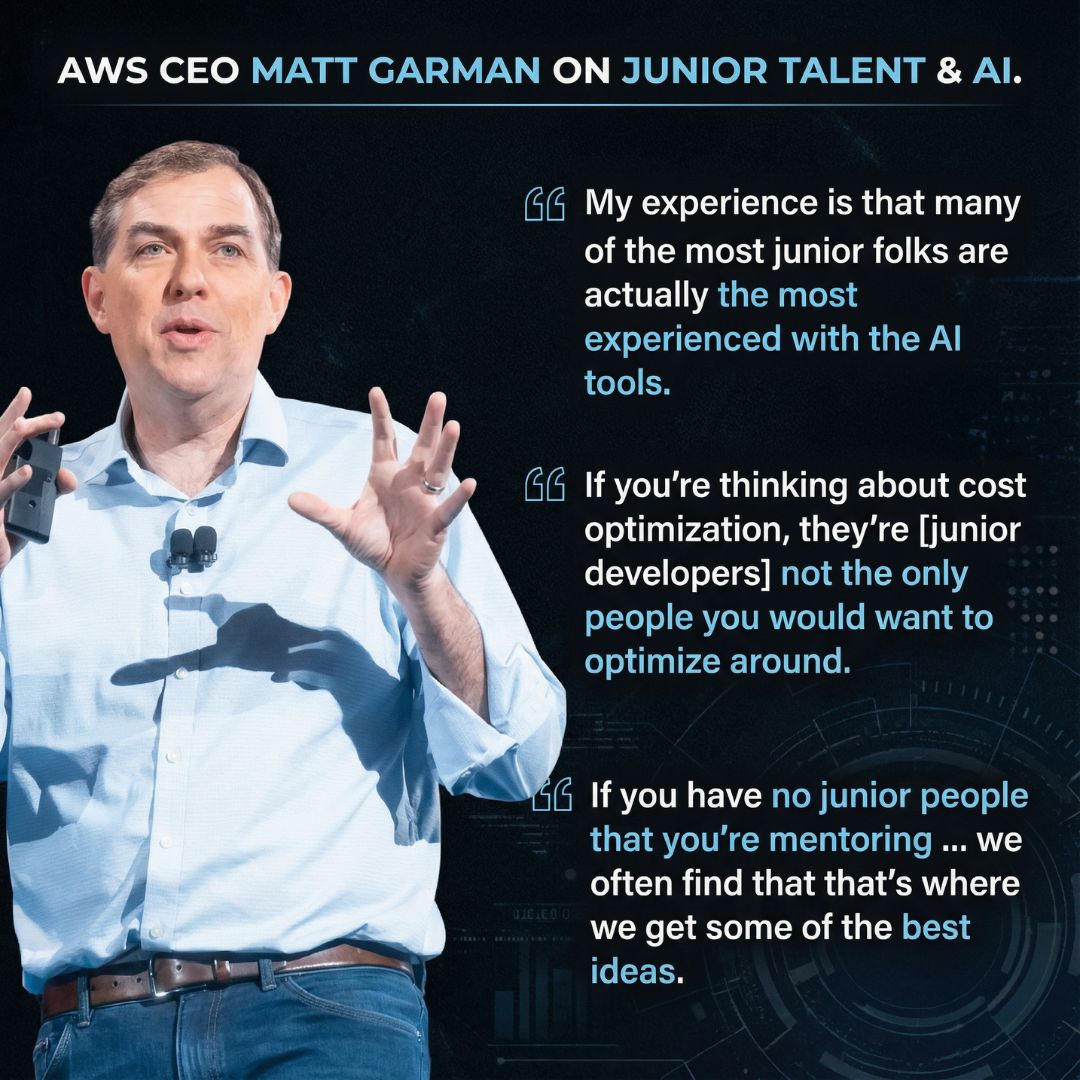
The tech industry’s favorite cost-cutting fantasy, replacing junior developers with AI, just got a reality check from one of the few people who actually knows what he’s talking about. Matt Garman, CEO of Amazon Web Services, didn’t mince words when he called the idea “one of the dumbest” he’s heard. But here’s what makes his critique more than just corporate lip service: it exposes a fundamental flaw in how we think about system design apprenticeship in the AI era.
The Three Pillars of Garman’s Argument
Garman’s reasoning breaks down into three points that, on the surface, sound like HR talking points. Dig deeper and you find a blueprint for why architectural knowledge transfer is about to get a lot more complicated.

First, junior developers are often the most experienced with AI tools. The 2025 Stack Overflow Developer Survey backs this up: 55.5% of early-career developers report using AI tools daily in their development process, a higher adoption rate than their senior counterparts. Fresh graduates have grown up with AI-powered IDEs, chat-based debugging, and code generation tools. They’re not just using them, they’re exploring edge cases, finding shortcuts, and pushing these tools beyond their intended use cases.
This creates an ironic dynamic: the people most likely to be replaced by AI are the same ones who know how to extract maximum value from it. As Garman put it, “they’re actually most able to get the most out of them.” The implication? If you cut your junior devs, you’re also cutting your AI power users.
Second, they’re the least expensive employees. This isn’t just about salary, though junior developers do earn significantly less than senior architects. It’s about cost optimization logic. If you’re looking to trim budgets, targeting your cheapest talent is mathematically nonsensical. Garman’s math is brutal: “if you’re thinking about cost optimization, they’re not the only people you would want to optimize around.”
But there’s a hidden cost here that most CFOs miss. The real expense isn’t the junior developer’s salary, it’s the knowledge gap that appears five years later when you need a senior architect and don’t have one.
Third, removing juniors breaks the talent pipeline. This is where Garman’s sports team analogy lands hard: “If you only keep veteran players and never recruit rookies, what happens when those veterans retire? You are left with no one who knows how to play the game.”

The pipeline problem is especially acute in system design. Architectural intuition, the ability to smell a bad design before it fails in production, doesn’t come from textbooks or AI-generated diagrams. It comes from years of watching systems fail, debugging production incidents at 3 AM, and absorbing the war stories from senior engineers over coffee.
The Apprenticeship Model Was Already Broken
Before AI entered the chat, the traditional path from junior to senior developer was already showing cracks. The Atlantic’s recent investigation into the entry-level hiring crisis revealed that grade inflation and AI-assisted applications have turned the recruitment process into “mush.” Two decades ago, fewer than a quarter of Harvard undergraduate grades were A’s. Today, 60% are. GPAs have become meaningless signals.
The result? Companies are drowning in applications that all look the same. AI-written cover letters and resume boosters have created a paradox: it’s easier than ever to apply for a job, but harder than ever to actually get one. Handshake data shows applications per job increased 26% in the past year, while job postings fell 16%.
This is the context in which Garman’s warning lands. The hiring process is already broken, and AI is both the cause and the proposed solution. Companies are using AI to screen AI-generated applications, creating what one talent strategist called “a really weird wild west” where “you’ve got two human beings trying to fight off the robot on the other side.”
Skills-Based Hiring Isn’t the Answer, It’s the Symptom
Business Insider’s analysis of the shift toward skills-based hiring frames it as an “operational necessity” in the AI era. Companies like Google and IBM have dropped degree requirements, focusing instead on data science and machine learning competencies. The argument is compelling: skills-based hiring reduces time-to-fill and improves productivity because applicants are “job-ready.”
But here’s the controversial take: skills-based hiring is accelerating the very problem Garman is warning about. When you prioritize immediate competency over long-term potential, you create a workforce of mercenaries who can execute tasks but can’t design systems. You get people who know how to use AI tools but don’t understand why the architecture matters.
The HHL Career Day panel on “Is AI Killing Entry-Level Jobs?” hit this point directly. Panelists argued that AI isn’t reducing entry-level roles but reshaping expectations. Companies now want candidates who can “navigate evolving tools, work comfortably with AI systems, communicate insights clearly, and adapt quickly.” These are valuable skills, but they’re not substitutes for deep architectural understanding.
What System Design Apprenticeship Actually Looks Like
Let’s be concrete. A junior developer learning system design doesn’t start with distributed consensus algorithms. They start with:
- Code reviews where a senior architect explains why a particular database query will cause problems at scale
- Incident post-mortems where they see how a seemingly minor design decision led to a 2-hour outage
- Architecture review meetings where they watch senior engineers debate trade-offs between consistency and availability
- Pair debugging sessions where they trace a performance issue through five layers of abstraction
This is messy, contextual, and deeply human. It’s not something you can learn from AI-generated documentation or ChatGPT explanations. The AI can tell you what a circuit breaker pattern is, but it can’t share the war story about the Black Friday outage that taught your team why it matters.
The AI-Accelerated Apprenticeship
This doesn’t mean AI has no place in junior developer education. In fact, the opposite is true. The HHL panel correctly noted that “AI accelerates how quickly technical skills can be learned”, making human strengths like “problem-solving, learning agility, adaptability, and intrinsic drive” more important.
The key is reframing AI as an accelerant, not a replacement. Here’s what that looks like in practice:
AI as a tutor, not a teacher: Junior devs can use AI to get instant explanations of concepts, generate example code, and explore edge cases. But they still need human mentors to provide context, correct misconceptions, and connect abstract concepts to real-world consequences.
AI as a pair programmer, not a replacement: Tools like GitHub Copilot can help juniors write boilerplate code faster, freeing up mental bandwidth to focus on architectural thinking. But they need senior guidance to understand when to accept AI suggestions and when to reject them.
AI as a simulation environment: AI can generate realistic system failure scenarios for juniors to debug, creating safe spaces to practice architectural decision-making. But humans must design these scenarios and debrief the outcomes.
The danger comes when companies see AI as a way to skip the apprenticeship phase entirely. Why hire a junior dev when AI can generate code? Why invest in mentorship when AI can answer questions? This is the short-term thinking Garman is warning against.
The Controversial Truth: We’re Measuring the Wrong Things
The real controversy isn’t whether AI can replace junior developers, it can’t, not if you care about long-term system quality. The controversy is that our industry is optimizing for the wrong metrics.
We’re measuring:
– Lines of code generated
– Tickets closed
– Features shipped
We should be measuring:
– Architectural debt accumulated
– Incident resolution time
– Knowledge transfer effectiveness
The Business Insider piece on skills-based hiring quotes a recruiting CEO saying that focusing on skills “reduces the time it takes to fill roles and improves productivity because applicants are ‘job-ready.'” But “job-ready” for what? For executing tasks, yes. For designing resilient systems, no.
A Deloitte report notes that the tech workforce is expected to grow at twice the rate of the overall U.S. workforce, highlighting the demand for tech talent. But demand for what kind of talent? If we fill that demand with AI-assisted mercenaries who can crank out code but can’t reason about systems, we’re setting ourselves up for a catastrophic failure of digital infrastructure.
The Future of Apprenticeship
So what does redefined system design apprenticeship look like? It’s not the old model, but it’s not AI replacement either. It’s something new:
1. AI-augmented pair programming: Senior architects pair with junior devs, but both have AI assistants. The AI handles syntax and boilerplate while humans focus on design trade-offs.
2. Contextual micro-mentorship: Instead of formal training programs, AI identifies knowledge gaps in real-time and connects juniors with relevant senior experts for 15-minute targeted sessions.
3. AI-generated failure simulations: AI creates realistic outage scenarios based on a company’s actual architecture, giving juniors safe spaces to practice incident response.
4. Architectural decision records reviewed by AI: Juniors propose design decisions, AI checks them against best practices and historical incidents, then senior architects provide final review and context.
The through-line here is augmentation, not replacement. AI handles the repetitive, pattern-matching work that can be automated, freeing up human mentors to focus on the contextual, judgment-based teaching that can’t be.
The Bottom Line
Garman’s confidence that “AI will definitely create more jobs than it removes at first” isn’t corporate optimism, it’s a recognition that complex systems require human judgment. The question isn’t whether junior developers have a future, but whether companies are willing to invest in the redefined apprenticeship model that future requires.
The controversy isn’t about AI capability. It’s about corporate patience. Building senior architects takes years and requires tolerating the mistakes junior developers make along the way. AI promises to shortcut that process, and the temptation to believe that promise is strong.
But the cost of that shortcut is a generation of engineers who know how to use AI tools but don’t understand the systems they’re building. They’ll be fast, productive, and dangerous, able to ship features at scale but unable to reason about the architectural debt they’re accumulating.
The companies that win in the AI era won’t be the ones that replace their juniors with AI. They’ll be the ones that figure out how to use AI to accelerate the apprenticeship process while preserving the human judgment that makes system design possible in the first place.
That’s not just a hiring strategy. It’s a survival strategy.
Ready to dive deeper? The conversation about AI’s impact on software development is just getting started. For a deeper look at how skills-based hiring is reshaping the industry, check out Business Insider’s analysis. If you’re interested in the academic perspective on AI’s impact on entry-level roles, the HHL Career Day panel discussion offers valuable insights.