And your delivery pipeline hasn’t budged.
A product manager at a transportation company recently voiced this exact frustration after rolling out AI tools across a team of eight. The engineers were faster. Tasks were completing quicker. Yet the team was still taking roughly the same amount of time to ship features. The culprit? QA had become the new bottleneck, and requirement clarity issues continued to cause endless back-and-forth.
If this sounds familiar, you’re not alone. The gap between individual velocity and team throughput is one of the defining paradoxes of the AI era, and it’s not going away until we stop treating AI as a silver bullet and start treating it as a constraint-revealing magnifying glass.
The Numbers Tell a Story of Two Realities
The disconnect between individual gains and organizational results is stark. Recent global survey data shows that 80% of professionals report AI has improved their personal productivity, and half say it helps them make better decisions. Only 13% express anxiety about their career prospects in an AI-driven world.
Yet when you zoom out to the enterprise level, the picture changes dramatically. The share of companies attributing meaningful financial impact to AI has barely budged, hovering around 37%. The proportion of true AI high performers, those attributing at least 5% of EBIT to AI, has stalled at just 6%.
The same pattern emerges in engineering specifically. While coding agents are scaling at roughly 31% of large enterprises, the productivity gains aren’t translating to faster delivery. One developer put it bluntly: “Nobody knows what we actually did so QA is a problem and without context we have to talk more.”
You replaced knowing things with ‘achieving’ things. But you still actually need to know things.
Why Individual Speed Doesn’t Equal Team Speed
The reason individual productivity gains don’t automatically translate to team throughput comes down to a fundamental misunderstanding of how work actually flows through organizations. As Thomas Bertels explains in his analysis of the AI productivity paradox, improving individual productivity does not automatically translate into better organizational performance.
Consider this scenario: an employee spends ten hours a week preparing presentations and analyzing data. With AI, she completes the same work in seven hours, a 30% reduction. Three hours are freed up every week.
But where do those hours go?
Unless something else changes, the company still pays for a 40-hour workweek. The employee may produce more presentations, spend more time in meetings, or simply take longer to complete other tasks. Her manager may not even know AI freed up those three hours.
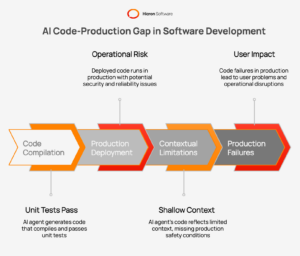
The same logic applies to software development. Your engineers are writing code faster, but the code still needs to be reviewed, tested, integrated, documented, and deployed. If those downstream processes haven’t improved, you’ve just created a bigger queue.
This isn’t just anecdotal. The data from DX’s Q3 State of AI Impact in Engineering report shows that while median weekly throughput is up 75.5% over four quarters, the rest of the SDLC is struggling to keep up. Organizations with the highest AI code volume wait 105% longer for a first review. Median PR size is up 122% year over year, there’s simply more code to review, and reviewers are hesitating because big AI-generated diffs are harder to trust.
The QA Bottleneck: Where AI Adoption Goes to Die
One of the most common bottlenecks teams hit is QA. In the transportation company’s case, QA was part of the team, but the workflow between dev and QA remained painfully sequential.
This is a structural problem, not a tooling problem. You can’t just hand your QA team Copilot and expect the bottleneck to disappear. The issue is that AI has supercharged the development side without addressing the verification side.
The prevailing sentiment among engineering teams is that QA would probably get the most out of AI today, if it were properly AI-empowered. But most organizations haven’t invested in AI-powered testing tools, automated test generation, or AI-assisted test case design. Instead, they’ve focused their AI budgets on code generation, which is exactly where the bottleneck already wasn’t.
The result? Developers are producing code faster than QA can validate it. The QA queue grows. Cycle time stays flat. And everyone wonders why the throughput numbers haven’t changed.
There’s also a deeper issue at play: the quality of what AI produces. As one developer noted, “People still need to understand what they are building because AI still goes rogue from time to time. I have seen slop get created which doesn’t do what I asked them to create. A bad dev just lets AI dictate the terms.”
The problem compounds when QA kicks back AI-generated code that doesn’t meet requirements, and the developer argues that the AI is correct. The requirements are the source of truth, not the model’s assumptions. That argument cycle adds time, frustration, and contention to an already strained process.
Requirements Are Still the Hardest Problem
Here’s the uncomfortable truth that AI adoption has exposed: poor requirements have always been the bottleneck. AI just made it more visible.
When a developer uses AI to spin up a feature based on unclear requirements, the AI doesn’t magically resolve the ambiguity. It makes assumptions, confident, well-structured, plausible-sounding assumptions that look great in a demo. Then QA kicks it back because it doesn’t match what the stakeholder actually wanted.
One developer described the situation perfectly: “Creating documentation faster doesn’t mean everyone is aligned on those requirements. No one reads and assumptions are a thing.”
What’s worse, AI has made the “not reading” problem worse. Teams are running full steam ahead to spec-driven development, and it’s devolved into everyone generating documents that just get passed to another LLM. Upstream assumptions and implicit debt pass along without a thought. The docs exist, but the alignment doesn’t.
This is a classic product management problem that AI can’t solve. Engineering not reading requirements has been a known issue for decades. It’s the kind of thing that comes up in interviews, that every PM has dealt with, and that no tool has ever fixed.
AI won’t resolve it either. Creating more documentation, faster, doesn’t create more alignment.
The Fix: Apply AI to the Constraint, Not Just the Easy Stuff
The teams that are actually seeing throughput improvements are following a simple pattern: use AI to fix the limiting process, find the next limiting process, and then use AI to fix that one too.
This iterative approach requires a shift in mindset. Instead of asking “how can AI make my developers faster?”, ask “where is work actually waiting in my system?” Then point AI at that specific constraint.
For teams with QA bottlenecks, that might mean:
- AI-powered test generation: Automatically generate test cases from requirements and acceptance criteria
- AI-assisted test triage: Use AI to classify failures, identify likely causes, and suggest fixes
- Shift-left testing: Bring QA into the development process earlier, with AI helping to identify edge cases and potential failure points during development
- Automated regression testing: AI-generated regression suites that expand as your codebase grows
For teams with requirement clarity issues:
- AI-assisted requirement validation: Use AI to check requirements for ambiguity, completeness, and testability before development starts
- Machine-readable acceptance criteria: Write intent, constraints, and acceptance criteria in a form AI can load and validate against
- Automated requirement traceability: Track which code changes map to which requirements, making it harder for assumptions to go unnoticed
One engineering team that tried this approach found that writing intent down first made code review dramatically easier. Their specs went through sixteen rounds of review, but after that, only one of seven task reviews failed, and that one was a test that proved less than the spec asked for. The investment in upfront clarity eliminated the painful back-and-forth that usually follows AI-generated code.
The Gap Between Velocity and Trust Is Growing
There’s a widening divide between code velocity and code trust. The latest data from DX shows that throughput is climbing while satisfaction with code maintainability has only improved by 0.6%. Developers report that AI is helping with isolated tasks like production debugging, which rose 13.3%, and documentation, up 10.4%. These are tasks with clear inputs, verifiable outputs, and short feedback loops, things AI does well.
The smallest gains are in tasks that require holding a whole system in view. The end-to-end experience of moving code safely into production, measured as perceived ease of delivery, improved by only 3%. Code maintainability barely moved.
What this suggests is that AI is helping developers navigate existing points of friction faster, but it’s not removing complex systemic friction. The innovation ratio, time spent on new features vs. maintenance and fixes, has barely moved. About 33% of AI sessions go to maintenance and 23.3% to fixes, against only 11% on new capability.
This means AI is intensifying workloads and contributing to burnout despite efficiency tools. Developers are more productive but not more fulfilled. They’re generating code faster but spending more time in review cycles. They’re shipping more but often in ways that degrade code quality over time.
The Bottom Line: Stop Measuring Productivity, Start Measuring Flow
The real issue isn’t that AI isn’t working. It’s that we’re measuring the wrong things. Individual productivity metrics, lines of code, tasks completed, velocity, were always a poor proxy for team performance. AI has just made that obvious.
The metric that matters is throughput: the number of work items entering the “Done” column per unit of time. That’s what your stakeholders care about. That’s what determines whether you ship on time.
Throughput is fundamentally different from velocity. Velocity measures estimated story points per iteration, throughput counts actual completed items. Velocity is easy to game, throughput is binary, done or not done. Velocity is based on averages, throughput is based on historical probability.
If your team’s throughput hasn’t improved despite AI adoption, the problem isn’t the tool. It’s the system. The answer isn’t to buy more AI licenses. It’s to find where the work is actually stopping, and point AI at that specific constraint.
The organizations that will close the gap between individual productivity and enterprise performance aren’t the ones with the most AI adoption. They’re the ones that redesign their workflows around AI capabilities rather than bolting AI onto existing processes.
The problem isn’t that AI isn’t making people more productive. It’s that most organizations haven’t changed how they work to capture that productivity.
The bottleneck isn’t the technology. It never was. It’s the organizational design, the financial discipline, and the willingness to reimagine how work gets done. The gains are real at the individual level. Translating them into enterprise impact requires not more AI adoption, but more organizational transformation.
And that’s a much harder problem than any model can solve.