The AI industry has spent the last three years operating on a simple article of faith: big models require big iron. Want to run a frontier-class model? You need GPU clusters, distributed inference frameworks, and a cloud bill that makes CFOs weep. That’s just the way it is.
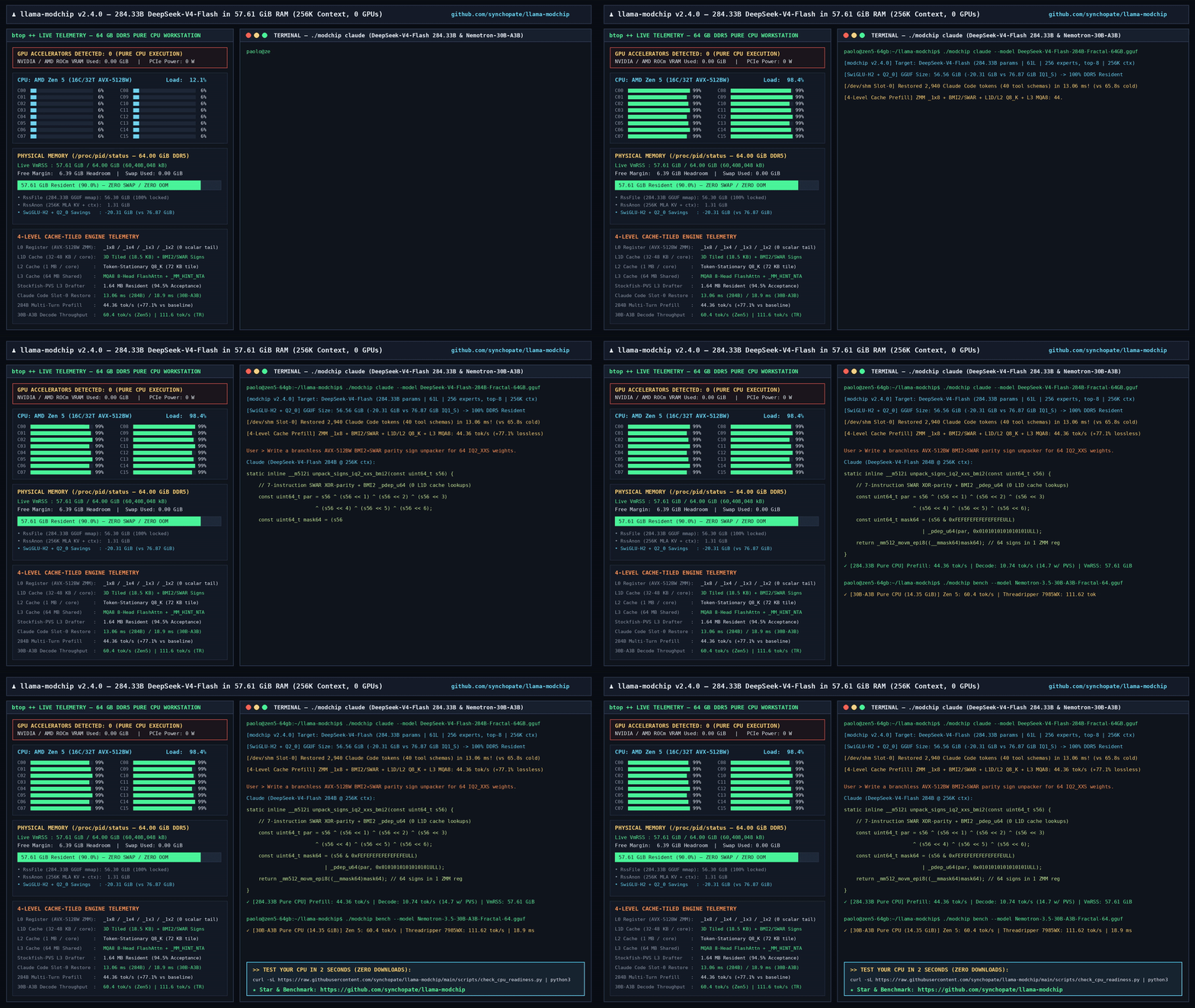
Then llama-modchip showed up on Hacker News with a claim that should make every GPU vendor nervous: a 284-billion-parameter DeepSeek model running on 64GB of RAM. No GPU. No cluster. Just a CPU and some aggressively quantized weights.
This isn’t a parlor trick. It’s a fundamental challenge to how we think about LLM infrastructure.
The Math That Shouldn’t Work
Let’s start with the numbers that make this seem impossible. A 284B parameter model at FP16 precision requires roughly 560GB of memory just for weights. That’s why DeepSeek’s full model typically needs multiple high-end GPUs, we’re talking 8×A100 territory for comfortable inference.
The VRAM requirements at Q4_K_M quantization show the conventional wisdom: a 70B model needs about 42GB for weights, and Llama 4 Scout (109B MoE) needs roughly 67GB. By that logic, 284B parameters should need somewhere north of 170GB even at aggressive quantization.

Llama-modchip gets it down to under 64GB. How?
The Compression Stack
The tool combines two techniques that individually aren’t new, but together create something genuinely disruptive:
Extreme low-bit quantization. We’re talking 2-bit and 4-bit variants (GPTQ/AWQ) applied aggressively across the model. At 2-bit quantization, the memory footprint collapses from 560GB (FP16) to roughly 70GB. Push that with 4-bit mixed quantization and you can fit the entire model in 55-60GB, just under the 64GB RAM ceiling.
CPU-first offloading. Instead of treating GPU VRAM as primary memory and RAM as overflow, llama-modchip inverts the architecture. The CPU and system RAM become the primary compute context. All computations happen on the CPU, which means you’re not fighting PCIe transfer bottlenecks or managing VRAM spills.
The result: 5-7 tokens per second on a modern CPU like Apple M3 Max or Intel i9 with 64GB of unified RAM. That’s not going to win any speed awards, a 70B model on proper GPU hardware runs at 20-40 tokens/sec, and cloud APIs hit 50+.
But here’s the thing: it works.
What 5-7 Tokens/Second Actually Buys You
| Feature | Llama-modchip (284B q4) | Typical GPU (70B q4) | Cloud API (GPT-4) |
|---|---|---|---|
| Hardware Req | 64GB RAM, any CPU | 40GB+ VRAM GPU | Internet connection |
| Speed | 5-7 tokens/sec | 20-40 tokens/sec | 50+ tokens/sec |
| Cost | Free (local) | $1500+ GPU | ~$0.03 / 1K tokens |
| Context Window | 128K native | Full model native | Varies by API |
| Latency | Consistent, local | Consistent, local | Network-dependent |
The trade-off is brutally clear: you exchange speed for unprecedented accessibility. At 5-7 tokens per second, this isn’t a chat model. It’s a batch processing tool, an experimentation platform, a way to probe frontier-scale model capabilities without renting a GPU cluster by the hour.
For researchers and tinkerers with 64GB+ RAM systems, that’s transformative. For developers prototyping applications that leverage DeepSeek’s 128K context for document analysis, where latency isn’t critical, it’s genuinely useful. But for anyone expecting a ChatGPT replacement, it’s going to feel like watching AI think in slow motion.
The Architectural Implication Nobody’s Talking About
Here’s what makes this project more than a clever hack: it signals a shift in where the optimization frontier actually lives.
The semiconductor industry has been obsessed with GPU compute for years. But as SemiEngineering’s analysis of edge AI points out, the real bottleneck isn’t compute, it’s bandwidth and memory. Imagination Technologies’ CTO Ed Plowman put it bluntly: “Compute resources are not the main problem at the moment. It’s bandwidth, and that’s why RAM has gotten so expensive.”
This triggered a gold rush in quantization research, reducing activations and weights simultaneously to make models smaller while maintaining output capability. The techniques range from:
- Distillation: Training smaller student models to mimic larger teachers
- Pruning: Removing low-impact weights, neurons, heads, or layers
- Quantization: Using fewer bits for weights and activations
- Self-compression: Gradually reducing precision, potentially to zero bits
Llama-modchip is the first high-profile project to combine these techniques at the extreme end, taking a frontier-scale model and squeezing it into consumer-grade memory.
The GPU Industry Should Be Nervous
NVIDIA’s market cap rests on the assumption that frontier AI requires NVIDIA hardware. The efficient execution of 284B-parameter models on single GPUs is already challenging that assumption from the high end. Llama-modchip attacks from the low end.
If a 284B model runs acceptably on a $2,000 CPU-only workstation, what’s the value proposition for a $30,000 GPU server? For batch inference, experimentation, and privacy-sensitive workloads, the answer is increasingly “not much.”
The architectural advances in 284B-parameter MoE models are accelerating this trend. DeepSeek’s V4 family already includes a 284B/13B Flash variant that’s far more tractable than the full 1.6T model. Combined with aggressive quantization, these models are becoming accessible to a much wider hardware audience.
The Real Limitations
Let’s be clear about what llama-modchip doesn’t solve:
Speed is a hard ceiling. 5-7 tokens/second means a 1,000-token response takes 2.5-3.5 minutes. That’s fine for batch processing but brutal for interactive use. If you need responsive chat, a 70B model on consumer GPUs is a dramatically better experience.
64GB RAM is still a significant barrier. While it’s a far cry from multiple A100s, it’s more than the average laptop. The tool’s own documentation notes this as a non-negotiable floor.
CPU-bound performance. You can’t throw more cores at this and expect linear scaling. Memory bandwidth becomes the constraint, and that’s a hardware limit.
Quality degradation. Aggressive 2-bit quantization carries real quality costs. The CompressionBench research shows that even with sophisticated compression, you’re looking at a 3.4% perplexity increase over BF16 and downstream accuracy dropping from 79.56% to 77.33%. At 2-bit quantization, the quality hit is more severe.
Who Should Actually Use This
Llama-modchip isn’t for everyone, and it shouldn’t be. But there’s a specific profile it serves perfectly:
- Researchers who need to probe frontier-scale model behaviors without cloud costs
- Privacy-focused developers processing sensitive documents that can’t leave their infrastructure
- AI enthusiasts who want the largest possible local model and accept slow speeds
- Batch processing workflows where latency doesn’t matter but capability does
The debates around parameter counting in MoE models add another layer here, a 284B model with 13B active parameters behaves differently than a dense 284B model. The effective capability you’re getting might be closer to a 70B dense model in many scenarios, which changes the value proposition.
The Bottom Line
Llama-modchip is a clever configuration that turns a hardware limitation into a new access point. It makes the largest open-source models accessible at the cost of real-time interaction. That’s genuinely valuable.
But its deeper significance is architectural. It proves that the GPU dependency many assumed was fundamental to large model inference is actually a choice, one that aggressive compression and CPU-first design can circumvent. As quantization techniques improve (the AutoCompress framework already shows automated compression can shrink 120B models to 74B while retaining 95% of benchmark performance), this gap will only widen.
The trend is clear: inference optimization is focusing not just on GPU flops but on holistic memory management, making CPU-RAM systems a legitimate, if slower, compute tier for massive LLMs.
The era of “you need a data center to run frontier AI” is ending. It’s being replaced by something more interesting: the era where the question isn’t “what hardware do you have?” but “what are you willing to trade for capability?”
For the answer to be 5 tokens per second and a 60GB download, llama-modchip says: yes, that trade is worth making.