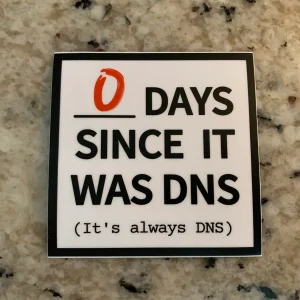
When DNSSEC Breaks Internet Availability: Lessons from the .de TLD Outage
DNSSEC was supposed to make the web safer. Instead, in May 2026, it became the single point of failure that broke access to millions of .de domains across Germany. The German ccTLD operator, DENIC, had a DNSSEC misconfiguration, and for a terrifying window, a significant portion of the internet’s recursive resolvers, the caches that answer user queries, rejected .de as “insecure.” Websites vanished. Email stalled. Online services ground to a halt. This wasn’t a DDoS attack or a hardware failure, it was a cryptographic security protocol doing its job too well, trading availability for a purity of security many didn’t know they had opted into. The .de outage is a masterclass in how a well-intentioned security layer, when mismanaged, can collapse core internet services. It exposes the brittle trust chain underpinning the modern web and forces a critical re-evaluation of the trade-offs between cryptographic perfection and practical reliability.
The Anatomy of a Cryptographic Single Point of Failure
To understand how DNSSEC can break the internet, you need to understand the chain of trust. DNS translates human-readable domain names (example.de) into computer-friendly IP addresses. DNSSEC adds digital signatures to DNS records, allowing resolvers to cryptographically verify that the answers they receive are authentic and haven’t been tampered with. It’s a hierarchical system:
- The root zone (
.) is signed by a Root Key Signing Key (KSK). - The Top-Level Domain (TLD) zone (
.de) publishes a Delegation Signer (DS) record in the root zone, signed by the root’s KSK, which points to its own Zone Signing Key (ZSK). - Subdomains (like
nic.de) can then create their own DS records in the parent TLD zone, and so on.
This creates a verifiable chain from the root, down to your specific domain. When a DNSSEC-validating resolver queries for nic.de, it doesn’t just fetch an IP, it fetches a cryptographic proof.
The .de failure likely stemmed from an inconsistency in this chain. Perhaps the DS record for .de at the root (held by IANA) didn’t correctly match the active KSK published in the .de zone files served by DENIC’s nameservers. Or, the signatures (RRSIG records) on the .de zone expired. In a non-DNSSEC world, these records would still resolve, the resolver would shrug and return the data. In a DNSSEC world, the validator follows the rules rigidly: a broken chain equals untrustworthy data equals SERVFAIL.
The technical logs from a tool like the Verisign DNSSEC Analyzer for nic.de show the chain in its healthy state. They detail the DS record (26755 8 2 f341357809a5954311ccb82ade114c6c1d724a75c0395137aa3978035425e78d) in the root zone and the corresponding DNSKEY in the .de zone. But when that chain snaps, when the signatures don’t match or have expired, the entire TLD disappears from view for validating resolvers.
The Silent Majority: How Validation Failures Cascade
The real problem wasn’t that DENIC made a mistake. Operators, being human, make mistakes. The systemic issue is how the ecosystem reacts. According to APNIC data, roughly 35% of internet users are behind DNS resolvers that perform DNSSEC validation. When .de’s DNSSEC chain broke, these users, over a third of the internet, were immediately cut off.
The cascade is brutal:
1. A user tries to visit a .de site.
2. Their ISP’s or public resolver’s (like Google’s 8.8.8.8 or Cloudflare’s 1.1.1.1) validating DNS software checks the DNSSEC signatures.
3. The validation fails. The resolver returns a SERVFAIL (Server Failure) to the user’s device.
4. The browser shows “server not found.” The site is, for all practical purposes, offline.
The .de outage is a stark reminder that infrastructure routing decisions and gateway identity crises aren’t limited to Kubernetes. They permeate the foundational layers of the internet, where a single misconfigured cryptographic key can have a global impact, akin to how encryption protocols disrupt load balancing and observability at higher layers.
The Root of the Problem: Key Management and Human Process
DNSSEC’s fragility isn’t a bug, it’s a feature of its stringent security model. The system is designed to fail closed. The primary culprits, as Sucuri’s analysis notes, are almost always human-process errors in key management:
- Mismatched or Missing DS Records: You update your zone signing key but forget to submit the new DS record to your registrar/TLD operator. The parent can’t vouch for you anymore.
- Expired RRSIG Signatures: DNSSEC signatures have a validity period (e.g., 30 days). If your automated signing job fails or you do it manually and forget, the signatures lapse. Your zone becomes “bogus.”
- Botched Key Rollovers: Rolling keys is a delicate, multi-step dance. Remove the old key before the new one has propagated globally, and you’ve broken the chain for everyone who hasn’t seen the update.
- Inconsistent Responses: If your authoritative name servers get out of sync, one serves signed data, another doesn’t, resolvers will randomly fail validation.
The root zone itself presents the ultimate key management challenge. Its Key Signing Key (KSK) has an intended lifetime of about five years but often lasts much longer. The first KSK served for eight years, its successor, KSK-2017 (keytag 20326), has also been active for nearly eight. A new KSK, KSK-2024 (keytag 38696), was added to the root zone DNSKEY Resource Record in January 2025. Its full adoption is critical. According to a detailed APNIC measurement using RFC 8509 sentinel probes, by April 2026, under 20% of users behind DNSSEC-validating resolvers had added KSK-2024 to their local Trust Anchor set. The planned roll to use KSK-2024 for signing in October 2026 carries a non-trivial risk of a global validation failure if adoption doesn’t accelerate dramatically.
Measuring the Unmeasurable: The Fog of Cryptographic Adoption
How do you know if the world is ready for a root key roll? You can’t just ask. The distributed, opaque nature of DNS makes measurement fiendishly difficult.
APNIC researcher Geoff Huston, in a blog post, details two methods: RFC 8145 signaling (where resolvers announce their trusted keys to root servers) and RFC 8509 sentinel queries (special domain names that test a resolver’s trusted keys). Both are noisy, uncertain, and don’t give a clear picture of user impact. The data shows a disturbing gap: while RFC 8145 data from root server operators suggested ~90% of reporting resolvers had adopted KSK-2024 by March 2025, the user-centric RFC 8509 measurement told a different story, widespread lack of readiness.
This opacity is dangerous. It means the internet’s core cryptographic upgrade is happening largely in the dark. Operators must “trust that implementations… operate with an accurate implementation of the relevant RFCs”, Huston concludes, a sobering admission for a global infrastructure change.
Practical Takeaways: Don’t Let Perfection Be the Enemy of Uptime
The .de outage and the looming root key rollforce hard questions about operational reality.
For Domain Owners
If you enable DNSSEC, you inherit a strict operational burden.
- Treat it like production code. Your DNSSEC key rotation is a deployment. Use automation, monitoring, and staged rollouts. Tools like
delv +dnssec, DNSViz, and the Verisign DNSSEC Analyzer are your CI/CD for DNS. - Monitor signature expiration. Set alerts for your RRSIG validity periods. An expired signature is an outage.
- Choose your provider carefully. A managed DNS provider that handles DNSSEC comprehensively is often worth the cost versus a manual registrar setup.
For Infrastructure Architects
This is a classic case of runtime configuration inconsistencies causing critical outages. DNSSEC configuration is code, it directly controls a critical path at runtime. Yet, it’s often managed through web UIs, manual file edits, and forgotten cron jobs.
- Design for graceful degradation. Should a validation failure trigger a hard
SERVFAIL, or could a monitoring system temporarily bypass validation for a critical TLD while alerting furiously? The industry standard says fail hard, but is that always the right business decision? - Instrument and monitor. Are you measuring DNSSEC validation failure rates from your users’ perspectives? You should be.
The lesson of .de is not that DNSSEC is bad. The cryptographic integrity it provides is vital for preventing cache poisoning and man-in-the-middle attacks. The lesson is that security at the infrastructure layer shifts the blast radius from “compromised data” to “complete unavailability.” It’s a trade-off we’ve made implicitly by deploying DNSSEC. The .de outage is the bill coming due, forcing the industry to mature its operational practices around this powerful, brittle technology. The next test comes in October 2026 with the root KSK roll. Let’s hope we’ve studied for it.