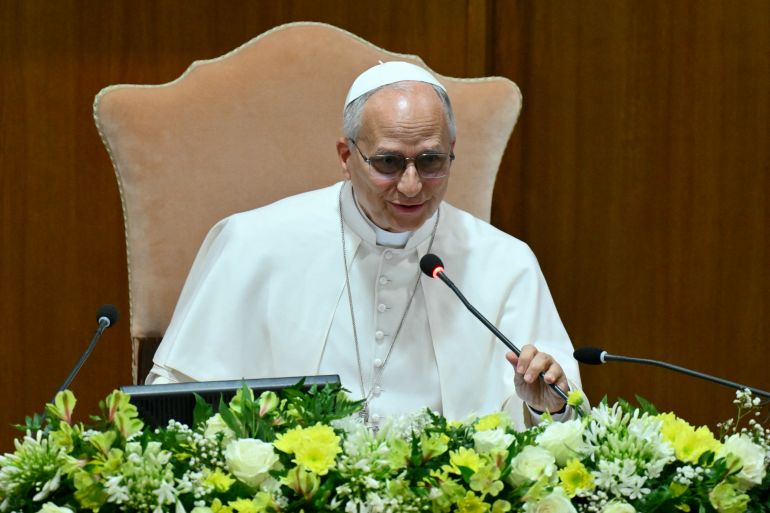
On Monday, Pope Leo XIV dropped what might be the most consequential 42,300-word document ever written about artificial intelligence. It’s not a scientific paper or a government white paper. It’s an encyclical, one of the most authoritative teaching documents a pope can issue, and it calls for nothing less than the “disarming” of AI.
The document, titled Magnifica Humanitas (Magnificent Humanity), doesn’t mince words. It criticizes the military and commercial AI race in terms that would make most tech executives deeply uncomfortable. And the Vatican’s choice of co-presenter, Anthropic co-founder Christopher Olah, turned what could have been a footnote into a headline.
The Document That’s 90 Pages in 11-Point Font
Let’s get the logistics out of the way. When someone says “42,300 words”, your brain doesn’t immediately visualize 90 pages of single-spaced 11-point text. But that’s exactly what this is. One Reddit user helpfully fed it into an AI summarizer and got back 500 words of condensed critique.
The timing isn’t accidental. The encyclical was released on the 135th anniversary of Rerum Novarum, Pope Leo XIII’s foundational text on labor and industrial capitalism. The current pope is explicitly positioning himself as the Leo XIII of the AI era, applying Catholic social teaching to what he sees as the defining moral test of our time.
His central argument is deceptively simple: AI must serve the human person, not replace, diminish, or dominate humanity. He rejects both the utopian promises and the fatalistic fears, arguing instead that AI can simulate human language, reasoning, and creativity but does not possess conscience, empathy, moral responsibility, or spiritual depth.
For that reason alone, he insists, decisions affecting human dignity cannot be outsourced to machines.
The “Disarming” Thesis That Upsets Everyone
The pope uses the word “disarm” repeatedly, and it’s doing a lot of work. He’s not just talking about weapons systems, though he certainly addresses autonomous weapons. He’s talking about disarming the entire competitive framework that drives AI development.
“When such power is concentrated in the hands of a few, it tends to become opaque and evade public oversight”, the encyclical states, “increasing the risk of distorted forms of development that give rise to new dependencies, exclusions, manipulations and inequalities.”
This is a direct critique of the VC-funded, military-adjacent, “move fast and break things” culture that dominates AI development today. The pope explicitly warns against letting efficiency and profit serve as the primary measures of progress.
He calls for “robust legal frameworks, independent oversight, informed users and a political system that does not abdicate its responsibility.” That’s not religious moralizing, that’s a concrete regulatory framework.
Why Anthropic’s Chris Olah Was There
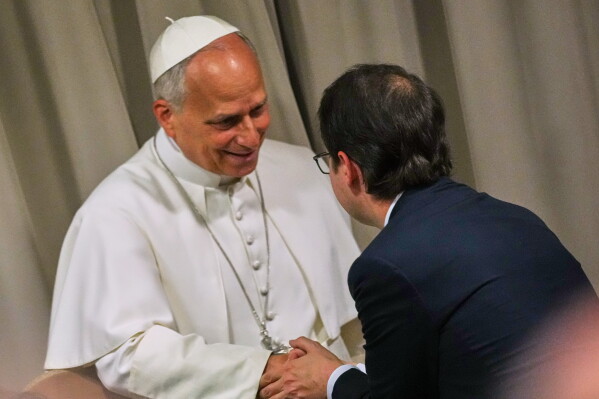
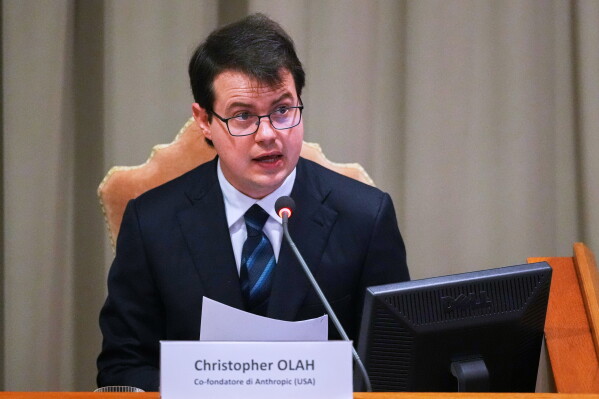
This is the detail that made tech Twitter lose its collective mind. The Vatican invited a co-founder of one of the most valuable AI companies on the planet to sit on stage with the pope during the presentation of a document that explicitly criticizes the concentration of power in companies just like his.
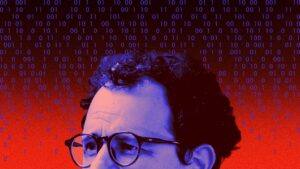
Out of everyone they could have invited from the AI industry, picking someone on the safety and transparency side says something about how seriously the Vatican scoped this out. Chris Olah is the head of interpretability at Anthropic, basically the guy trying to reverse engineer what these models are actually doing internally. He’s not Sam Altman. He’s not Demis Hassabis. He’s the person who’s been most vocal about the risks of uninterpretable black-box models.
During the presentation, Olah said something that deserves to be quoted extensively: “AI companies operate inside a set of incentives and constraints that can sometimes conflict with doing the right thing.” He welcomed input from outside actors like the Catholic Church to “push events in a better direction.”
The decision to include Anthropic was criticized by some who considered it a papal stamp of approval. But the encyclical’s content suggests otherwise. The document repeatedly blasts the concentration of power and data in private hands, calling for external regulation.
“Companies like his operate inside a set of incentives and constraints”, Olah acknowledged, “such as under strong commercial, geopolitical and personal pressures, that can sometimes conflict with doing the right thing for the broader interests of society.”
That’s not a defense of the industry. That’s a confession.
The Slavery Apology That Changes Everything
Hidden within the 42,300 words is a moment of institutional self-reflection that the Vatican has never attempted before. Pope Leo issued the first-ever papal apology for the Holy See’s role in legitimizing slavery.
“If you think this doesn’t matter for the AI debate”, one Vatican official told reporters, “you haven’t been paying attention.”
The connection is explicit. The encyclical warns against “new forms of slavery” due to the digital economy, referencing the hidden exploitation of workers behind the scenes who clean data and train models. The pope draws a direct line between the church’s historical failure to condemn slavery and the current failure to regulate the AI industry.
“It is impossible not to feel deep sorrow when contemplating the immense suffering and humiliation endured by so many”, the encyclical states, “in stark contrast to their immeasurable dignity as persons infinitely loved by the Lord.”
This is the pope pre-butting the inevitable accusation that he’s overreaching. He’s saying, in effect: “We’ve been wrong before. We’re not going to be wrong again.”
The Three Fronts of AI Regulation
Military AI: The “Just War” Theory Is Dead
The pope declares that the Catholic Church’s just war theory, which provides specific criteria for when force can be justified, is now “outdated” given the technological advances of warfare. He notes that AI can “bring conflict about more quickly and render it more impersonal.”
“No algorithm can make war morally acceptable”, he writes. This is a direct shot at the Trump administration’s deregulation policies and the use of AI in the Iran conflict.
Labor: The End of Work as We Know It
Olah mentioned during the presentation that there’s “a real possibility that AI will displace human labor at very large scale.” The pope echoes this, warning that the pursuit of greater profits cannot justify “choices that systematically sacrifice jobs, because the human person is an end, not a means.”
This is the most directly actionable part of the encyclical. The pope is calling for economic policies that protect workers, not just shareholders.
Privacy: The Surveillance Economy
The encyclical warns that AI systems can “turn personal data into a tool for manipulation” and that digital platforms are designed to “capture attention, exploit vulnerability and shape behavior.” The pope describes the ability to profile, predict, and direct people at scale as a new form of power, especially dangerous for the poor and socially marginalized.
The $4.8 Trillion Elephant in the Room
UN data projects the global AI industry will hit $4.8 trillion by 2033. That’s more than the GDP of most countries. The encyclical’s critique of “the culture of power” driving the AI race is, in effect, a critique of the entire economic model that has underpinned the technology sector for the last decade.
The encyclical explicitly warns that ownership of AI data must not be left solely in private hands. It calls for policymakers to protect the rights of workers and keep children safe from the technology. It urges the cooling of competition between AI companies.
“What is needed is a more active political involvement that is capable of slowing things down when everything is accelerating”, the pope said.
This is a radical statement coming from the leader of one of the world’s largest institutions. The Vatican is essentially saying: the market will not solve this. Only regulation, strict, enforceable, global regulation, can prevent the worst outcomes.
The Trump Administration’s Response
Vice President JD Vance, who converted to Catholicism in 2019, called the encyclical “very profound” in an interview with NBC News. But other administration officials were less charitable. Secretary of the Interior Doug Burgum criticized the document on Fox Business, saying, “I didn’t know that tech editorializing was part of the role of being pope.”
The Trump administration has taken a hands-off approach to AI regulation, with President Trump delaying signing an executive order that would have given the government oversight over new models before their release. The encyclical’s critique of deregulation is clearly aimed at this administration.
The anthill of tension between the Vatican and Washington, which has been building over the Iran war, just became a mountain.
What This Actually Means for AI Developers
Let’s get practical. The encyclical doesn’t have the force of law in any country. But it has enormous moral and political weight. It will be read by policymakers, regulators, and activists around the world. It will be cited in legislative debates, in court cases, and in academic papers.
For AI developers, the implications are threefold:
First, the encyclical provides a moral framework that can be used to justify regulation. If you’re an AI safety researcher inside a major company, you now have a document from one of the most respected institutions on Earth that backs up your concerns.
Second, the encyclical explicitly calls for transparency and accountability. “It is not enough to invoke ethics in the abstract”, the document states. “Robust legal frameworks, independent oversight, informed users and a political system that does not abdicate its responsibility are required.”
Third, the encyclical gives ammunition to those who argue that AI development should be slowed down. The “race to the bottom” that Olah warned about is now being criticized by the highest moral authority in the Catholic Church.
The Tower of Babel Warning
The encyclical makes a striking biblical reference to the Tower of Babel. In the biblical story, humans, out of pride and arrogance, constructed a city with a singular language. God confused their language, fracturing the people’s unity.
The pope warns that AI could create a similar situation, a concentration of power and knowledge that ultimately dehumanizes rather than elevates.
“To disarm does not mean rejecting technology, but preventing it from dominating humanity”, he writes. The technology should be “human-friendly”, accessible to all, and opened to discussion and debate.
This is the core of the encyclical’s message: the question is not whether humanity can build more powerful machines, but whether it can remain fully human while doing so.
The Verdict
Is Magnifica Humanitas going to stop the AI race? No. Is it going to change how Google trains its models? Unlikely. Is it going to make VC firms suddenly care about worker rights? Don’t hold your breath.
But the encyclical is something more valuable than a policy document. It’s a rallying cry and a moral framework. It articulates concerns that many people have but cannot express as coherently. It connects the dots between autonomous weapons, labor displacement, surveillance capitalism, and environmental destruction.
And it puts the full weight of the Catholic Church behind the argument that AI development must be subject to democratic control.
The 42,300 words are a lot to process. But the message is simple: the AI race is not inevitable, not natural, and not beyond our control. We can choose to slow down, to regulate, to prioritize human dignity over corporate profit.
The question is whether anyone will listen.