Somewhere between the term sheets and the closing dinner, someone at NVIDIA looked at a $12.9 billion acquisition price and thought: “You know what this needs? A Unicode easter egg.”
And honestly? It’s the most on-brand thing either company has ever done.
When Hugging Face cofounder Thomas Wolf announced the acquisition with a parenthetical nudge, “(special congrats if you find the Hugging Face and Nvidia references hidden in our $12,930,300,000 acquisition price)”, the internet did what the internet does best: it went absolutely feral decoding the number.
Here’s what they found.
The Emoji That Launched a Thousand Spreadsheets
The first six digits of that absurdly precise figure, 129,303, are the decimal representation of Unicode code point U+1F917. That’s the 🤗 emoji, officially registered as “Hugging Face” in the Unicode standard.
Let me translate what happened: NVIDIA priced the acquisition of a company literally named after an emoji at the numeric value of that emoji.
It’s the kind of move that makes finance bros weep into their Excel models and makes every engineer who’s ever filed a bug report feel seen.
But wait, there’s a second layer. The same sequence, read as a hex color code #129303, renders a vibrant green that looks suspiciously close to NVIDIA’s signature brand color. Clément Delangue eventually confirmed this after the internet spent hours arguing about whether the digits split as 12/93/03 (NVIDIA’s $12 IPO price in 1999, founding year 1993, and three cofounders) or as a color code.
The collective reaction from X was summed up pretty well by one commenter who joked about “negotiating a $13 billion deal just to land on the hug emoji.” Others were less charitable, asking whether this constituted “a breach of directors’ responsibilities.”
The Real Number Behind the Meme
Before you dismiss this as billionaires playing games with Monopoly money, let’s look at what actually happened here.
The deal values Hugging Face at roughly 86x revenue, about $150 million annualized against that $12.93 billion price tag. It’s NVIDIA’s second-largest acquisition ever, trailing only the $20 billion Groq asset deal from last year and blowing past the $7 billion Mellanox acquisition in 2019.
For context, NVIDIA’s market cap sits around $5.5 trillion. This whole purchase costs them about 0.23% of the company.
Here’s where the “it’s just a meme number” argument collapses: the joke cost real money. By my math, landing on $12,930,300,000 instead of a round $13 billion left roughly $70 million on the table. That’s the “negotiation” Julien Chaumond joked about when he said it was the “first time I ever had to negotiate a price down.”
That $70 million figure isn’t chump change. It’s more than the UN struggled to raise to scrap a decaying oil tanker off Yemen that threatened to destroy the Red Sea ecosystem. But when you’re NVIDIA and you’re buying the distribution layer for open-source AI, the last hundred million apparently matters less than landing the joke.
A History of Tech Easter Eggs in Financial Documents
NVIDIA and Hugging Face didn’t invent this game. They just played it at a scale nobody’s seen before.
Google, whose very name is a play on “googol”, set the precedent back in 2004 when its IPO filing announced an intention to raise $2,718,281,828. That’s Euler’s number e to nine decimal places. In 2016, Google did it again with a $7,019,340,976.83 stock buyback, e raised to the 26th power, a nod to Alphabet’s 26 letters.
The pièce de résistance remains the ex-Google employee who accidentally purchased google.com through Google Domains for a brief, glorious minute. Google “thanked” him with a reward of $6,006.13, which reads as “GOOGLE” when you map the digits to letters. ($6 = G, 006 = OOG, .13 = LE.)
So this NVIDIA move isn’t breaking tradition, it’s continuing a proud Silicon Valley tradition of nerds hiding jokes in the most boring documents imaginable.
The Real Ugly Question: Is This a Red Flag?
The cynical take, and there are plenty of them floating around Reddit, is that a joke price tag reveals how unmoored tech valuations have become from reality.
This was the top sentiment in the discussion thread on Reddit, where the top comment dismissed the whole thing as proof that “all this is just made up and not grounded in reality.” Another user pointed out the absurdity of “the cost of living ris[ing] while billionaires and massive companies make memes with huge amounts of money.”
But here’s the thing: these critics aren’t entirely wrong, and they’re not entirely right either.
Deals of this scale rarely close with literal stacks of cash. This is almost certainly a stock-and-equity swap where the actual value fluctuates by tens of millions of dollars in either direction between the announcement and close. There’s a valuation range built into the deal, and the final number gets pinned when the paperwork is signed.
As one commenter noted, identifying the exact stock trade to the second would produce a different number anyway. So why not pick the one that spells out an emoji?
The deeper question, the one that should actually worry you, is what this means for the open-source AI ecosystem.
Buying the “Switzerland of AI” for the Price of an Emoji
Hugging Face has long positioned itself as neutral ground, the “Switzerland of AI”, hosting over three million models including every open Chinese model that competes with NVIDIA’s biggest customers.
Delangue himself said just this month that China is winning the AI race because it embraced open models. Now the most valuable company on Earth owns the distribution layer for every model that doesn’t belong to them.
NVIDIA was already on Hugging Face’s cap table from the Series D round in August 2023, when it invested at a $4.5 billion valuation alongside Salesforce Ventures, Google, Amazon, Intel, AMD, Qualcomm, and IBM. That stake just marked up 2.9x before NVIDIA bought the rest.
The strategic logic is brutal and clear: NVIDIA doesn’t want anyone else owning the front door to open-source AI. Anthropic and OpenAI are both building their own chips to reduce NVIDIA dependence. This acquisition ensures that the open models running on NVIDIA’s Nemotron hardware and the quantized formats that require NVIDIA GPUs all funnel through infrastructure NVIDIA controls.
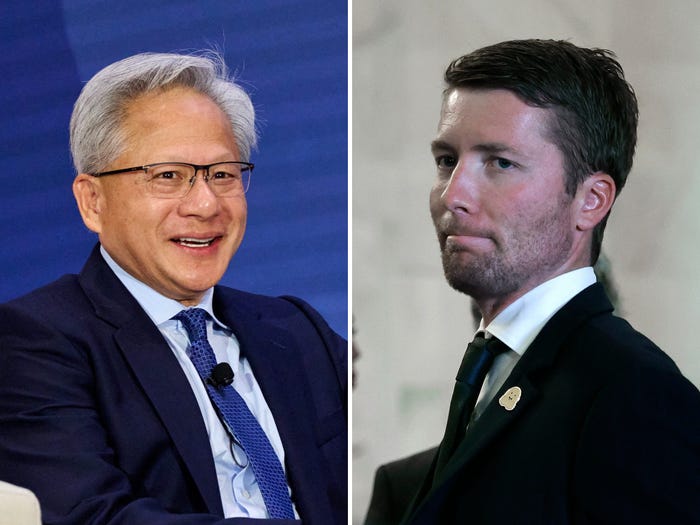
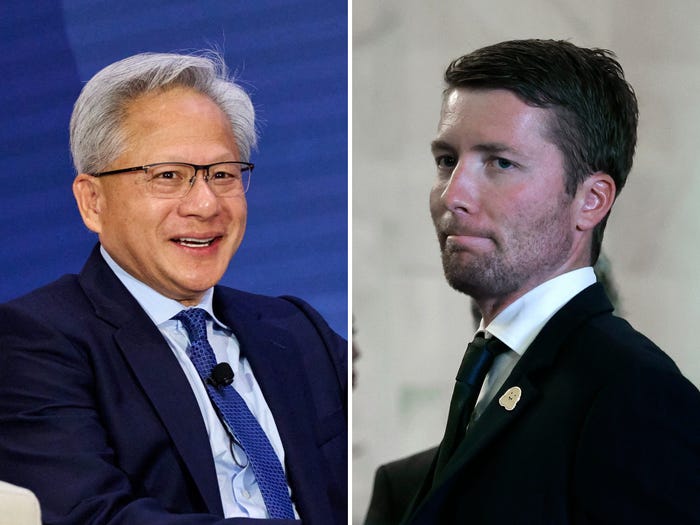
Jensen Huang has promised Hugging Face stays open with no requirement to use NVIDIA compute. We’ve heard that before from acquirers. The track record is… mixed.
What the Cap Table Says About AI’s Wealth Distribution
Founders
Let’s talk about who actually made money here, because the numbers are genuinely wild.
Hugging Face raised about $395 million across eight rounds and never raised again after 2023. The three founders, Delangue, Chaumond, and Wolf, started the company in New York in 2016. Working through dilution, they likely held somewhere between 33% to 38% combined at exit.
That’s roughly $4.3 billion to $4.9 billion split among three people, or about $1.5 billion each.
Employees
The 250 employees? If the option pool represents 15-20% of the company, that’s $1.9 billion to $2.6 billion spread across the team, averaging $8-10 million per employee, with early engineers far above that.
For comparison: Anthropic’s roughly 5,000 employees share a much larger pie, but per-capita, Hugging Face’s team just won the lottery. Airtable’s founders split $144 million after 13 years. These numbers are in a different universe.
The Only Number That Actually Matters
Here’s the fact that should shape how you read this whole story: Hugging Face rejected a $500 million investment from NVIDIA at a $7 billion valuation last year. By declining, they avoided about 7% dilution and sold the whole company 18 months later at 1.85x that price.
That’s the kind of negotiation outcome that MBA case studies are written about. Delangue said on X that he was “surprised people didn’t notice earlier” about the easter egg, adding that it “shows that price was never really the most important thing for both sides.”
That’s either the most confident negotiation statement ever made, or the most dangerous signal about how AI companies evaluate their own worth.
The Bloomberg report on Tuesday had the deal at roughly $14 billion. It closed at $12.93 billion, the codepoint number. The joke mattered more than the last hundred million. That’s either fiscal discipline disguised as whimsy, or whimsy that cost shareholders real money.
I’ll let you decide which is more concerning.
The Last Laugh
Ten years ago, a company named after an emoji rebuilt Google’s BERT in PyTorch essentially by accident and became the front door to open-source AI. Now the most valuable company on Earth bought it for the numeric value of that emoji, and the internet can’t decide whether to laugh or scream.
The $12,930,300,000 price tag is simultaneously the most transparently nerdy thing in corporate history and a stark reminder that AI’s infrastructure is consolidating under a handful of players.
Whether you read $12.93 billion as a loving tribute or a red flag probably says more about your relationship with Big Tech than it does about the deal itself.
But here’s my take: when NVIDIA’s model compression strategy and Hugging Face’s community-driven development ethos collide, the result will be measured in how much of the open-source ecosystem remains genuinely open, not in how clever the press release was.
The emoji was the hook. The consolidation is the story.