KLING 3.0 dropped this week, and if you’re still thinking of AI video as a fancy GIF generator that occasionally gets hands right, you’re already behind. The Chinese model’s latest iteration doesn’t just incrementally improve quality, it fundamentally rewires the relationship between visual generation, audio synchronization, and narrative structure. While Western labs are busy optimizing single-shot coherence, KLING is shipping what amounts to a pre-visualization director that fits in your browser.
The headline features read like a wishlist from every frustrated AI filmmaker: up to six camera cuts in a single generation, native audio-visual co-generation, and lip-sync that doesn’t look like a bad dub from the 70s. But the real story isn’t in the feature bullet points, it’s in the architecture choices that suggest KLING’s team has been watching where every other model stumbles.
The Multi-Shot Problem Nobody Actually Solved
Every AI video model can generate a decent 5-second clip. That’s table stakes. The moment you try to create a second clip with the same character in a different angle, everything falls apart. Faces morph. Clothing changes color. The laws of physics become suggestions. This isn’t just annoying, it’s a fundamental blocker for any real storytelling.
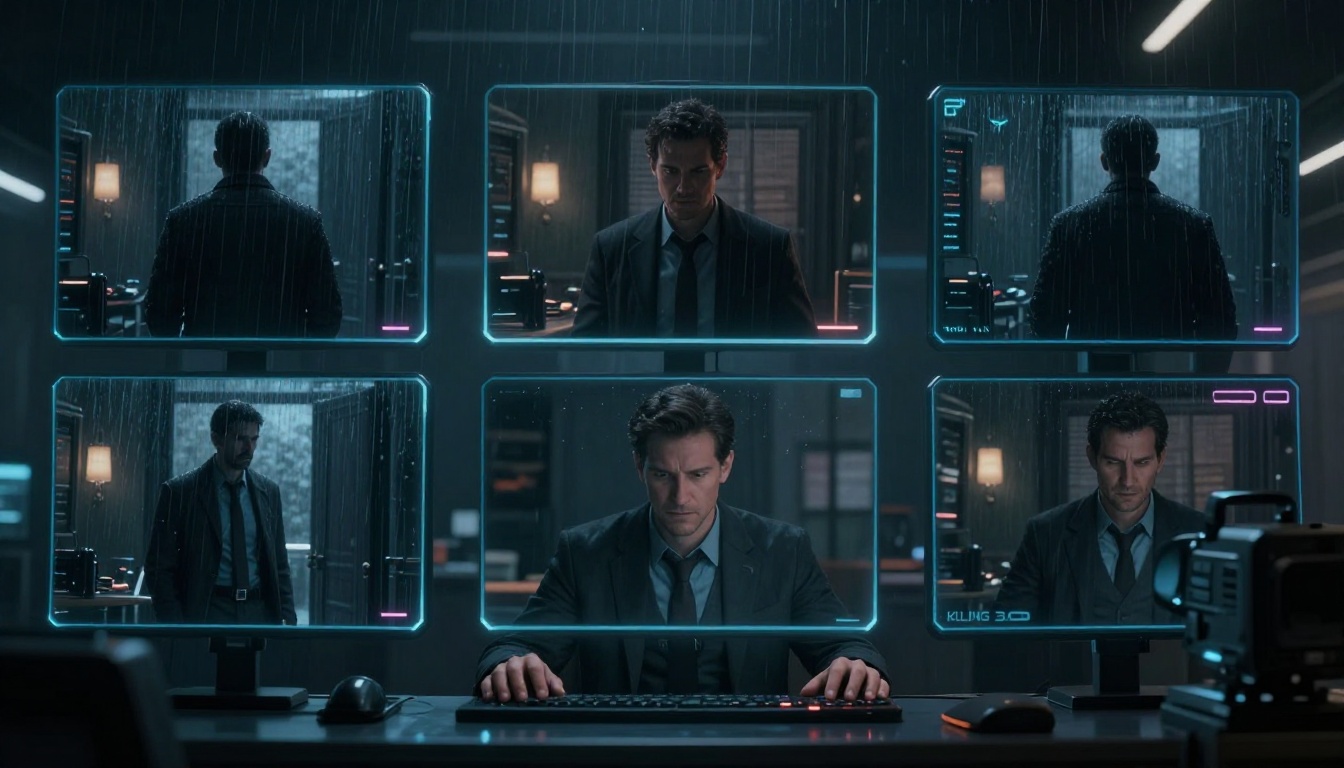
KLING 3.0’s multi-shot generation tackles this by embedding per-character identifiers that persist across camera cuts. According to early access reports, the model uses a combination of reference embedding caching and latent space temporal smoothing to maintain identity. Translation: it remembers what your protagonist looks like, even when switching from a wide establishing shot to a close-up.
The practical impact? A creator can define a three-shot sequence, say, a detective entering a room, cut to her face noticing a clue, cut to a detail shot of the evidence, and KLING maintains consistent lighting, wardrobe, and facial structure without manual intervention. One early tester noted that transitions between shots “maintain character and environmental consistency” in a way that previously required manual masking and frame-by-frame correction in After Effects.
This isn’t just a technical flex. It’s a direct attack on the post-production bottleneck that makes AI video workflows so painful. The model is essentially doing pre-visualization and rough assembly simultaneously.
Native Audio: Why Lip-Sync Finally Works
Here’s where things get spicy. Previous AI video workflows treated audio as an afterthought: generate silent video, then run a separate lip-sync model to match dialogue. The result was always slightly off, like watching a movie where the audio track was nudged two frames late.
KLING 3.0’s native audio-visual co-generation means both modalities emerge from the same generation pass. The research suggests this isn’t just parallel processing, it’s a unified architecture where audio and visual streams influence each other during generation. When a character speaks, the model isn’t just pasting a mouth shape onto existing footage, it’s generating the facial musculature, tongue position, and jaw movement in concert with the sound wave itself.
Early tests show the system handles three-person dialogue with reliable speaker attribution, correctly matching lip movements and voice assignments in group conversations. That’s a nightmare scenario for post-sync workflows, and KLING is shipping it out of the box.
The model also generates environmental audio that matches the visual context, a cityscape gets appropriate ambient noise, footsteps sync with floor contact, and room tone adjusts based on visible space. This kind of spatial audio matching typically requires a sound designer’s careful foley work. KLING is automating it by understanding the relationship between what you see and what you should hear.
The “AI Director” Workflow: From Prompt to Storyboard
KLING’s most provocative feature might be the “AI Director” storyboard workflow. Instead of writing elaborate prompts and hoping for the best, creators can define shot lists with explicit camera movements, durations, and cut points. The model interprets scene coverage and shot patterns directly, adjusting composition automatically.
This is where the software development angle becomes unavoidable. The system exposes production controls that read like a cinematographer’s checklist: dolly in, track left, crane up, rack focus. You can specify shot sizes (wide, medium, close-up) and lens characteristics (35mm, shallow DOF). For developers building creative tools, this is a dream API, structured inputs that map directly to cinematic language.
The prompt engineering guide from CometAPI shows how this works in practice:
“Shot 1, Wide establishing shot: city skyline, dusk, crane pullback 5s, slow dolly left. Action: silhouette of protagonist on rooftop.”
“Shot 2, Medium shot: protagonist on rooftop, 35mm, dolly in 3s, she checks a device and frowns.”
This structured approach reduces prompt ambiguity and gives creators predictable, repeatable results. It’s the difference between asking an intern to “make something cool” and giving a seasoned DP a shot list.
Subscription Tiers and the Access Wall
Here’s the controversy: Ultra subscribers get exclusive early access, and there’s confusion about whether existing “Ultimate” subscriptions include KLING 3.0. One Reddit user asked point-blank: “My Ultimate subscription doesn’t include Kling 3.0. Do I need to buy a new subscription?”
This tiered rollout strategy is creating a two-tiered ecosystem where access to the most capable models is gated behind premium pricing. While KLING hasn’t published detailed pricing for 3.0, the pattern mirrors what we’ve seen across the AI industry: the gap between “good enough” and “actually production-ready” is widening, and it’s priced accordingly.
The compute requirements are substantial. Native 4K generation with multi-shot sequences and audio synthesis burns GPU hours. Expect higher credit costs per generation for the full feature set, with a freemium tier that teases capabilities but watermarks outputs or limits resolution.
This raises a thorny question for developers: are we building on a platform that will be economically viable at scale, or are we prototyping on a tool that only large studios can afford in production?
The Open-Source Shadow: MOVA’s Silent Challenge
While KLING builds walls, the open-source community is kicking down doors. OpenMOSS’s MOVA model delivers synchronized video-audio generation with 18B active parameters and fully open weights. It’s not quite at KLING 3.0’s level for multi-shot coherence, but it’s close enough to make the subscription model look like a bet against commoditization.
The contrast is stark: KLING offers polished UX and integrated workflows but locks you into their ecosystem. MOVA gives you the raw capability to build whatever you want, but you’re responsible for the infrastructure. For developers choosing a path, this is a fork-in-the-road moment.
The broader context is the global AI infrastructure race. Moonshot AI just raised $500M to build API-first AI infrastructure, and South Korea’s Upstage is dropping 102-billion-parameter models with commercial licenses. KLING 3.0 isn’t just a product release, it’s a strategic move in a geopolitical chess match over who controls the creative AI stack.
Real-World Testing: The Gap Between Demo and Production
Early access testers on Higgsfield report that KLING 3.0 “handles temporal coherence better than previous versions”, but they’re also flagging limitations. The 15-second cap still constrains narrative scope, and complex choreography with rapid background changes can produce artifacts.
One tester noted: “The 15-second cap still limits narrative applications, but the quality improvement within that window is noticeable.” That’s the reality check. KLING 3.0 is a massive leap for short-form content, social ads, product teasers, music videos, but it’s not replacing your RED camera for feature films.
The model also struggles with dense crowd scenes and complex physics interactions. These are the edge cases that separate “good enough for a pitch deck” from “actually broadcast-ready.” For now, top-tier mixing, sound design, and color grading remain human tasks.
What This Means for Creative Workflows
KLING 3.0 is forcing a rethinking of the creative pipeline. When you can generate a rough cut with synchronized audio in one pass, the role of the editor shifts from assembler to curator. The model becomes a creative partner that produces options, not a tool that executes exactly what you specify.
For product managers building creative tools, the implications are clear: integration points matter more than raw generation quality. The winners will be platforms that let creators iterate quickly, refining specific shots without regenerating entire sequences, swapping audio while preserving visual continuity, and exporting editable assets rather than final renders.
For software architects, KLING’s approach suggests a pattern: multimodal models work best when modalities are co-designed, not bolted together. The API surface should reflect creative intent (shots, scenes, characters) rather than technical implementation (latent spaces, diffusion steps).
The Bottom Line
KLING 3.0 isn’t perfect, but it’s the first AI video model that feels like it was designed by people who actually make videos. The multi-shot coherence solves a real pain point. The native audio generation eliminates a workflow step that never worked well. The storyboard interface respects how directors think.
The controversy isn’t whether it’s good, it’s whether the closed, subscription-gated model can outrun open-source alternatives that are catching up fast. For now, KLING 3.0 is the tool to beat for short-form cinematic content. But in six months, we’ll see if that lead is sustainable or if it’s just another waypoint on the road to commoditization.
If you’re a developer or creative pro, the smart move is to build abstraction layers. Don’t marry KLING’s API directly, wrap it in interfaces that let you swap in alternatives as the market evolves. Because the only constant in AI video right now is that today’s breakthrough is tomorrow’s baseline.
Ready to experiment? The CometAPI playground offers early access to KLING 3.0 endpoints, and Gaga AI provides specialized avatar workflows if your focus is talking-head content rather than cinematic sequences. Just remember: the model is the engine, not the car. You’re still the driver.