The training cutoff date on your local LLM used to be a brick wall. Ask any model about events after 2024 and you’d hit that familiar “I cannot provide information beyond my knowledge cutoff.” But that wall is crumbling, and fast. Users are plugging local LLMs gaining internet access via DuckDuckGo to bypass stale training data. The irony? DuckDuckGo itself just became the biggest beneficiary of a very different kind of AI revolt.
Last week, Google announced at I/O 2026 that it would replace the familiar list of blue links with an AI agent that answers queries, executes tasks, and runs background monitoring. The response wasn’t just criticism, it was action. DuckDuckGo’s US app installs jumped 30% in a single week, and on iOS, that number peaked at nearly 70%.
The privacy-focused search engine, which has been stuck at roughly 2% of the US search market for years, suddenly found itself with the kind of growth that usually requires a Super Bowl ad. One Google I/O announcement moved its install numbers more than anything DuckDuckGo has done on its own.

What Actually Changed at Google I/O
The announcement wasn’t subtle. Google said the familiar list of blue links is going away, replaced by an AI agent that handles queries end to end. Background monitoring agents run alongside, anticipating your next move before you make it. The company framed it as the future of search.
Users framed it differently.
The complaint isn’t that AI is involved. The complaint is that there’s no way to opt out. Google’s AI Overviews appear whether you want them or not, surface inaccurate responses often enough to erode trust, and complicate searches that used to be simple. Someone tried searching the word “disregard” and got an AI-generated mess instead of results. That single incident became a symbol of the problem.
DuckDuckGo CEO Gabriel Weinberg put it directly: “Google is force-feeding AI with no way to opt out. As a result, their results are getting worse, not better.”
That framing is doing actual work for DuckDuckGo right now. The opt-out argument is simple, easy to understand, and lands cleanly against Google’s all-in approach. It doesn’t require users to care about privacy or antitrust or open web economics. It just requires them to be annoyed, and a lot of them are.
The Numbers That Matter
Let’s look at the actual data from TechCrunch and DuckDuckGo’s own reporting:
| Metric | Growth Rate | Peak |
|---|---|---|
| US app installs (avg WoW) | 18.1% | 30.5% (May 25) |
| iOS installs (avg WoW) | 33% | 69.9% |
| noai.duckduckgo.com visits (avg WoW) | 22.7% | 27.7% (May 24) |
App analytics company Apptopia independently verified a 29% increase in average daily downloads in the US and 12% globally over the same period.
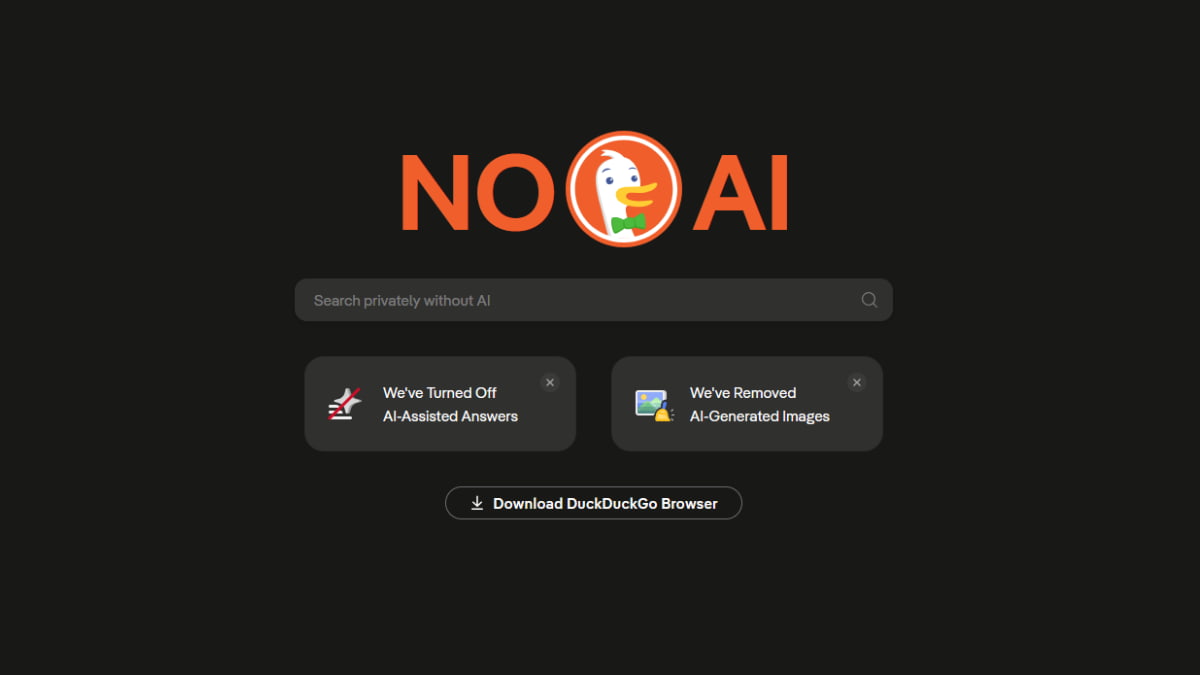
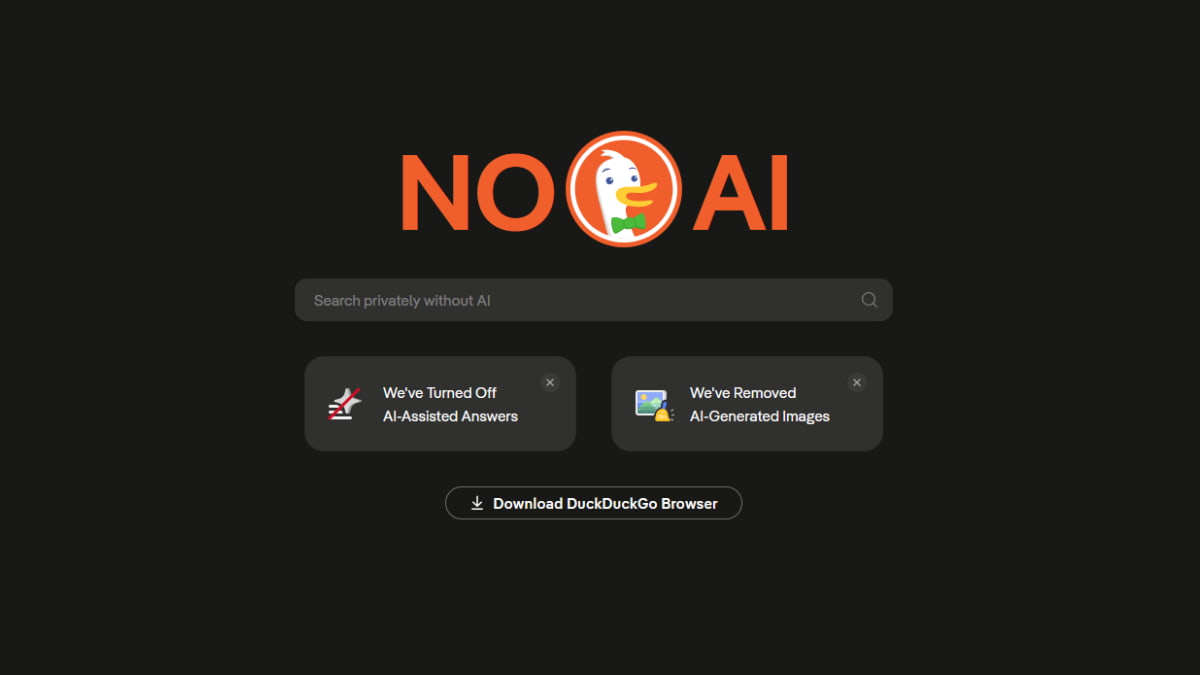
The noai.duckduckgo.com data point is particularly revealing. That page strips every AI feature by default, no AI-assisted answers, no AI-generated images. The fact that it’s growing faster than general installs suggests users aren’t just downloading DuckDuckGo out of curiosity. They’re specifically looking for the AI-off experience. “Opt out of AI” isn’t just a slogan, it’s the product.
The Memorial Day weekend data is the one worth watching. DuckDuckGo said it usually sees a traffic dip over the holiday weekend, and this year, it didn’t. If growth holds through a period that historically softens it, that’s a signal the shift has some real durability.
The Irony DuckDuckGo Doesn’t Talk About
Here’s where it gets interesting. DuckDuckGo isn’t actually anti-AI. It has its own AI product called Duck.ai, free, no account required, with access to Claude 4.5 Haiku, Llama 4 Scout, Mistral Small 3, and GPT-5 mini. All chats are private, IP addresses stripped before requests reach model providers, conversations deleted within 30 days, nothing used for training.
It also offers Search Assist, similar to Google’s AI Overviews, and an AI Image Filter that removes AI-generated images from results. Kamyl Bazbaz, DuckDuckGo’s chief communications and policy officer, said both are among the company’s most popular features despite sitting on opposite ends of the AI preference spectrum.
The difference isn’t that DuckDuckGo is against AI. It’s that everything is optional. You choose how much AI you want. Google made that choice for you.
That distinction is sharper than it sounds. A dedicated no-AI version of the search engine disables AI-assisted answers and AI-generated images by default. Users don’t have to install a browser extension, add a search operator, or hunt through settings. They can just use a different URL.
Google does not offer the same clean switch. There are workarounds, the Web filter, browser-level tricks, but they’re not the same as a standard setting that says classic search should remain the default.
Why This Isn’t Just a Privacy Story
For years, DuckDuckGo’s primary selling point was simple: search without tracking. Privacy resonated with a vocal minority but never moved the needle on market share. The company remained stuck at 2% because most users didn’t care enough about privacy to change their default search engine.
The AI backlash changes that equation. Privacy is abstract. Being annoyed by an AI summary that contradicts what you know and blocks the link you wanted is concrete.
There’s also a business story underneath the consumer backlash. If AI search answers more questions directly on Google’s results page, fewer people click through to the websites that created the information in the first place. Publishers, bloggers, review sites, and niche forums are watching AI Overviews closely. Search traffic has long been imperfect, but it still paid for a large part of the open web.
DuckDuckGo benefits from positioning itself as the less extractive alternative. It doesn’t build its business around personal search histories, and its AI tools don’t train on user conversations. For a privacy-focused brand, AI is less dangerous when it’s framed as a tool the user controls, not a layer the platform imposes.
The 2024 Google Leak Connection
What makes this moment particularly charged is context. In 2024, a massive leak of internal Google search documents essentially confirmed what many had suspected for years: Google was boosting “trusted” domains while telling everyone the algorithm was purely organic. The AI Overviews thing just made the editorial hand impossible to hide anymore.
One Reddit user put it bluntly: “The 2024 leak of internal Google search docs basically confirmed they were boosting ‘trusted’ domains while telling everyone the algorithm was purely organic. The AI Overviews thing just made the editorial hand impossible to hide anymore.”
Reusing code without explicit permission is a legal minefield, but manipulating search results while pretending algorithms are pure is a trust problem. Google’s AI overhaul didn’t create that trust deficit, but it made it visible in a way that even casual users can feel.
Will the Momentum Stick?
A 30% install spike from a 2% market share base is momentum, not a market shift. The question is how many of these installs survive the first week when muscle memory kicks in and fingers type google.com anyway.
The Memorial Day data suggests at least some durability. Growth held through a weekend that historically softens DuckDuckGo’s numbers.
What Google has done is hand a real argument to every alternative search engine that was struggling to articulate why anyone should switch. Privacy wasn’t enough. Speed wasn’t enough. The forced AI overhaul gave DuckDuckGo something it couldn’t manufacture on its own: a reason that feels personal to ordinary users who just wanted to search for something and got an AI agent instead.
For the first time in a long time, DuckDuckGo doesn’t have to explain why it exists. Google did that for them.
The real question for product managers and engineers watching this unfold isn’t whether DuckDuckGo can sustain this growth. It’s what happens when users start feeling the same way about AI integration in every other tool they use. The backlash against forced AI isn’t just a search engine story, it’s a product design signal that’s getting louder by the day.
Google can absorb a burst of DuckDuckGo downloads. It cannot ignore the signal behind them. People aren’t rejecting AI because they never want help. They’re rejecting the feeling that search has become something done to them rather than something they control.