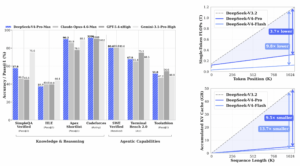
DeepSeek V3.1’s release on Hugging Face achieved a 71.6 % pass rate on the Aider coding benchmark while reducing the cost of Claude 4 by a factor of thirty-two. This release marks a significant shift in the landscape between open-source accessibility and proprietary models.
what the aider score reveals
Aider evaluates practical coding tasks: model inputs include repository refinements, function rewrites, or unit test fixes. Each task is scored automatically, measuring syntactic correctness and test satisfaction. Community discussions on LocalLLaMA highlight how this benchmark is becoming a standard reference point.
| Model | Passes / Total | Pass Rate | Cost per Test |
|---|---|---|---|
| DeepSeek V3.1 | 161 / 225 | 71.6 % | $0.0045 |
| Claude 4 | 159 / 225 | 70.7 % | ~$0.30 |
| GPT-4 Turbo | 151 / 225 | 67.1 % | ~$0.02 |
| Earlier DeepSeek-V3 | 93 / 225 | 41.3 % | $0.004 |
The 41 % to 71 % jump exceeds typical parameter scaling gains. The model is freely downloadable, fine-tunable, and deployable on private GPU clusters.
technical advancements in deepseek v3.1
hybrid training and expert routing
DeepSeek combines chat, reasoning, and coding data into a unified transformer. A mixture-of-experts strategy assigns relevant experts per token, maintaining low effective token lengths while supporting 128K context windows. This allows processing long documents without sacrificing response efficiency.
precision-optimized inference
The model offers BF16, FP8, and F32 variants. FP8 handles most tasks on modern GPUs, with BF16 used only when precision is critical. Testing shows 30-40 % throughput gains over BF16-only MoE models.
context-aware retrieval
Reverse-engineering identified four search tokens (e.g., [URL], [CODE]) that enable lightweight internal retrieval from training data. This feature supports documentation-driven reasoning without external APIs.
benchmark reliability and implications
- Task focus: Aider evaluates coding (non-reasoning) tasks, where DeepSeek outperforms 2024 open-source models while reducing costs from €70K API fees to ~$1 per test.
- Transparency: The 225 public GitHub repos used in testing ensure reproducibility. Unit test scoring is direct and unambiguous.
- Open access: The release enables independent benchmarking without vendor-specific constraints.
The Aider score provides a concrete metric for comparing open-source and commercial models in coding scenarios.
operational considerations
| Factor | Insight | Action |
|---|---|---|
| Cost | $0.0045/test ≈ $0.28 per function | Deploy on-premises or low-cost GPUs. No licensing fees. |
| Latency | ~1.3 s per test case | Replace interactive QA tools with batch processing for CI pipelines. |
| Customization | Open weights and precision variants | Fine-tune for niche use cases or microservices. |
| Regulatory | No US export restrictions | Suitable for regions facing chip bans. |
open vs. closed ai: key questions
-
Cost vs. quality
A $1-per-test model achieving 70% pass rates challenges assumptions about paid LLMs. The cost-benefit ratio may redefine “quality” in practical scenarios. -
Ecosystem dynamics
Open-source models foster plugin ecosystems. If DeepSeek becomes a standard, it could disrupt commercial API pricing models. -
Security and governance
While open weights enable transparency, they also increase misuse risks. Code-generation tools may require governance frameworks to mitigate harm. -
Geopolitical context
A Chinese startup releasing a 685 B-parameter model globally signals a shift in AI development. This challenges perceptions of geographic innovation hierarchies, as noted by VentureBeat and WebProNews.