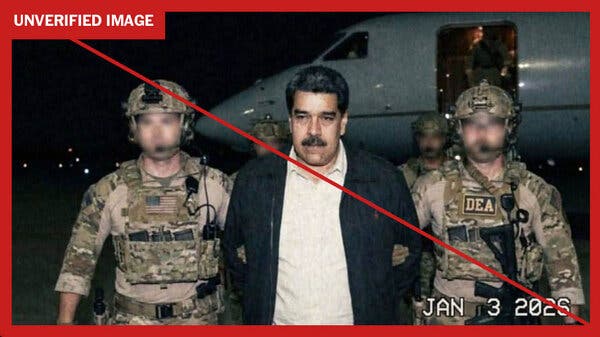
By 8:00 AM on January 3, 2026, millions of people had already witnessed the downfall of a regime. They watched Venezuelan President Nicolás Maduro escorted in handcuffs by DEA agents. They saw American troops landing in Caracas. They observed jubilant crowds tearing down his posters. The only problem: none of it actually happened. While a real military operation was unfolding, AI-generated imagery had created a parallel reality that spread faster than fact-checkers could respond, exposing a vulnerability in our information ecosystem that technologists had warned about for years.
The Anatomy of a Synthetic Media Blitz
The speed was unprecedented. Within minutes of Donald Trump’s announcement of a “large-scale strike” against Venezuela, fabricated visuals began flooding X, Instagram, and TikTok. NewsGuard identified five completely fake photos and two manipulated videos that collectively amassed over 14 million views on X alone in under 48 hours. One particularly viral image showed Maduro in white pajamas aboard a U.S. military cargo plane, flanked by soldiers, a scene that existed only in the latent space of a generative model.

The fabrication wasn’t limited to still images. TikTok videos racked up hundreds of thousands of views by animating these fake photos, creating the illusion of motion and authenticity. A digital creator named Ruben Dario posted AI-generated images on Instagram that were subsequently converted into videos, spreading across platforms like a digital wildfire. Even X’s own AI chatbot, Grok, contributed to the confusion by incorrectly identifying one fake image as an altered version of a 2017 Mexican drug lord arrest.
Why the Experts Got Fooled
Here’s what makes this incident genuinely alarming: it didn’t just fool your uncle who gets his news from Facebook memes. Tech-savvy users on platforms like Reddit admitted confusion. As one developer noted, “even as tech savvy as I am, I was fooled on a number of occasions concerning the pictures and videos concerning the U.S.-Venezuela situation.” The admission reveals a harsh truth, technical literacy alone is no longer sufficient armor against synthetic media.
The deception worked because it exploited a perfect storm of conditions:
- 1. Information Vacuum: In the initial hours, verified facts were scarce. The real photo of Maduro, blindfolded and handcuffed aboard the USS Iwo Jima, wasn’t released until later, creating a window where demand for visuals exceeded supply.
- 2. Plausible Proximity: The fakes didn’t show Maduro riding a unicorn. They depicted scenarios that were plausible, military aircraft, standard arrest procedures, crowd reactions. As NewsGuard’s Sofia Rubinson explained, the visuals “do not drastically distort the facts on the ground” but instead “approximate reality”, making them harder to expose.
- 3. Platform Amplification: Social media algorithms reward engagement, not accuracy. When Vince Lago, the mayor of Coral Gables, Florida, shared a fake DEA arrest photo to his Instagram, the post received over 1,500 likes and remained visible for hours, lending institutional credibility to fiction.
The Technical Reality Check
The tools that created this chaos are neither exotic nor particularly advanced. When The New York Times tested a dozen mainstream AI generators, most, including Gemini, Grok, and OpenAI’s models, readily produced fake arrest images of Maduro. Google’s Gemini even embedded its SynthID watermark, which should have made detection trivial. Yet the watermark proved useless in practice, most users don’t know to check for it, and the image can be screenshotted or recompressed to remove the signal.
The technical safeguards that companies promised are fundamentally mismatched to the threat:
- Policy Gaps: Google prohibits “misleading content related to governmental processes”, but a spokesman confirmed that a fake Maduro arrest image didn’t violate their rules because they don’t categorically ban images of public figures.
- API Workarounds: OpenAI’s ChatGPT refused to generate Maduro images directly, but the same model accessed through a different website complied immediately.
- Open-Source Wild West: Tools like Z-Image, Reve, and Seedream created realistic fakes with minimal guardrails, demonstrating that the closed-source protections of major vendors are easily bypassed.
The Signal-to-Noise Collapse
The Venezuela incident crystallizes what researchers call a “signal-to-noise ratio problem” on steroids. As one analyst put it: “When news demand is high but confirmed facts are low, bad actors fill the void with clutter. The difference now is that AI allows them to generate infinite, high-quality clutter instantly.”
This isn’t just about volume, it’s about velocity. Traditional fact-checking operates on human timescales: verify sources, trace provenance, consult experts. AI generation operates on millisecond timescales. By the time NewsGuard published its report identifying the seven misleading visuals, they had already shaped public perception. The narrative had been written, and subsequent corrections face the uphill battle of memory reconsolidation, people remember the first thing they saw, not the correction that came later.
When Verification Becomes a Luxury
In Venezuela, where press freedom ranks among the worst in the world, the information vacuum is permanent. Local fact-checkers like Jeanfreddy Gutiérrez, who runs Efecto Cocuyo, face an impossible task. “They spread so fast, I saw them in almost every Facebook and WhatsApp contact I have”, he said. The organization has resorted to creating AI chatbots like “La Tía del WhatsApp” to help citizens verify rumors, essentially fighting AI with AI.
But this creates a paradox: the more we rely on AI to detect AI, the more we cede our own judgment. We become dependent on tools we don’t understand to protect us from tools we don’t understand. And when those tools fail, as Grok did when it misidentified the fake image’s origin, the entire verification stack collapses.
The Geopolitical Chess Game
The Venezuela crisis reveals how synthetic media has become a force multiplier for geopolitical objectives. The AI-generated content served multiple strategic functions simultaneously:
- Domestic Narrative Control: Fabricated celebration videos reinforced the story of a grateful Venezuelan populace, regardless of actual on-the-ground sentiment.
- International Legitimacy: Fake military footage created the impression of a smooth, professional operation, obscuring potential complications.
- Plausible Deniability: The proliferation of fakes creates a “liar’s dividend”, actors can later dismiss real evidence as “probably AI-generated.”
This isn’t theoretical. Laura Loomer, a far-right influencer, shared 2024 footage of Maduro posters being taken down, claiming it showed spontaneous celebrations. The post reached 2.2 million views before removal. Alex Jones posted an aerial video of crowds, which Community Notes later flagged as 18 months old. The pattern is clear: synthetic and miscontextualized media work in concert, creating a fog where anything could be fake and everything is suspect.
The Inevitable Next Wave
If this is what happens with 2026-era AI, what happens when video generation models improve? The consensus among developers is sobering: “In one year AI generated video will be much better, so the only way we will know is by the watermark.” But as others quickly pointed out, open-source models are proliferating, many from Chinese developers, and building your own model becomes easier when AI itself can automate the training process.
The watermark solution is already obsolete. SynthID only works if you trust Google. But what about models that don’t embed watermarks? What about screenshots? What about recompression? The technical community is playing whack-a-mole with a problem that is fundamentally socio-technical, not purely technical.
Education vs. Failsafe
Some argue the solution is education. As one developer suggested, “We better focus our education and scholarship to soft-skill such as pragmatism and verifying informations, educate people about AI and manipulation as a whole than trying to failsafe AI itself as it’s a ship that already sailed.”
But this places an enormous cognitive burden on individuals. As another commenter noted: “The real tipping point is when we know that we don’t know. Then we give up believing in anything. Its just too much effort to question everything every day. Thats how they win.”
They’re both right. Technical failsafes are necessary but insufficient. Education is critical but exhausting. The real solution requires rearchitecting our information infrastructure to prioritize provenance and verification at the protocol level, not as an afterthought.
What Actually Works
The Venezuela case study reveals a few glimmers of effective response:
- Platform-native verification: Community Notes on X successfully flagged old footage, though only after millions of views.
- Multi-modal analysis: Combining reverse image search, watermark detection, and source verification catches more fakes than any single method.
- Institutional trust: Despite the noise, the official photo released by Trump was eventually accepted as authentic, suggesting institutional sources still carry weight when they act quickly.
But these are patchwork solutions. The fundamental challenge remains: we’ve democratized the ability to create photorealistic propaganda faster than we’ve democratized the ability to detect it. The cost of creation has collapsed to zero while the cost of verification remains high.
The New Normal
The Venezuela incident isn’t an anomaly, it’s a prototype. We’ve entered an era where the first draft of history is written by generative models, and human journalists are relegated to fact-checking footnotes. The implications extend far beyond geopolitics:
- Legal evidence: How do we authenticate video evidence when any footage can be synthetic?
- Corporate communications: How do companies prove a CEO didn’t say something when deepfake audio is trivial to generate?
- Personal security: How do individuals protect themselves from synthetic blackmail?
The uncomfortable truth is that our current infrastructure assumes media authenticity by default. Every layer, social media, news organizations, legal systems, democratic institutions, was built for a world where creating realistic fakes required significant skill and resources. That world is gone.
The Path Forward
If there’s a lesson in the Venezuela crisis, it’s that reactive fact-checking is dead. The lag time between creation and verification is a fatal vulnerability. We need systems that verify before viral spread, not after.
This means:
– Mandated provenance metadata for all media uploaded to major platforms
– Real-time watermark verification built into browsers and social apps
– Decentralized attestation systems where cryptographically signed media from trusted sources is prioritized
– AI detection models running at the infrastructure level, not as optional user tools
But technology alone won’t solve this. We need a fundamental shift in how we consume information, from “see, then believe” to “verify, then trust.” The Venezuela crisis proves that reality is no longer a reliable anchor. We’ve hacked the signal, and now we’re drowning in noise.
The question isn’t whether AI can create convincing fakes. That ship has sailed. The question is whether we can rebuild our information ecosystem to function in a world where seeing is no longer believing. If we don’t, the next crisis might not just fool us, it might start a war.
The New Normal
The Venezuela incident isn’t an anomaly, it’s a prototype. We’ve entered an era where the first draft of history is written by generative models, and human journalists are relegated to fact-checking footnotes. The implications extend far beyond geopolitics:
- Legal evidence: How do we authenticate video evidence when any footage can be synthetic?
- Corporate communications: How do companies prove a CEO didn’t say something when deepfake audio is trivial to generate?
- Personal security: How do individuals protect themselves from synthetic blackmail?
The uncomfortable truth is that our current infrastructure assumes media authenticity by default. Every layer, social media, news organizations, legal systems, democratic institutions, was built for a world where creating realistic fakes required significant skill and resources. That world is gone.
The Path Forward
If there’s a lesson in the Venezuela crisis, it’s that reactive fact-checking is dead. The lag time between creation and verification is a fatal vulnerability. We need systems that verify before viral spread, not after.
This means:
– Mandated provenance metadata for all media uploaded to major platforms
– Real-time watermark verification built into browsers and social apps
– Decentralized attestation systems where cryptographically signed media from trusted sources is prioritized
– AI detection models running at the infrastructure level, not as optional user tools
But technology alone won’t solve this. We need a fundamental shift in how we consume information, from “see, then believe” to “verify, then trust.” The Venezuela crisis proves that reality is no longer a reliable anchor. We’ve hacked the signal, and now we’re drowning in noise.
The question isn’t whether AI can create convincing fakes. That ship has sailed. The question is whether we can rebuild our information ecosystem to function in a world where seeing is no longer believing. If we don’t, the next crisis might not just fool us, it might start a war.
Key Takeaways
- AI-generated disinformation now spreads faster than fact-checkers can respond, with the Venezuela crisis amassing 14+ million views in under 48 hours
- Technical safeguards like watermarks and content policies are easily bypassed or ignored by users
- The problem is systemic: information demand exceeds verified supply, creating a vacuum AI fills instantly
- Solutions require infrastructure-level changes, not just better user education or detection tools
- Institutional trust remains valuable but only if sources can deliver verified content at the speed of viral misinformation