There’s a moment in every technological revolution where the gear stops being strictly utilitarian and becomes a statement. In the 1960s, it was the hot rod, a Chevelle with a blower sticking through the hood, built not because it was the cheapest way to get to work, but because it could be built. In the 2020s, that energy has migrated from the garage to the spare bedroom, and the machine in question isn’t burning gasoline. It’s burning kilowatt-hours.
This is the era of the 8x GPU water-cooled AI behemoth.
These rigs, towers of consumer RTX 3090s or repurposed data center V100s, plumbed with custom water loops, powered by dual 1600W power supplies, and anchored to motherboards that cost more than a used Honda, are not just compute clusters. They are cultural artifacts, the physical manifestation of a subculture that refuses to accept that AI belongs only to the hyperscalers.
Not Just Performance, But Obsession
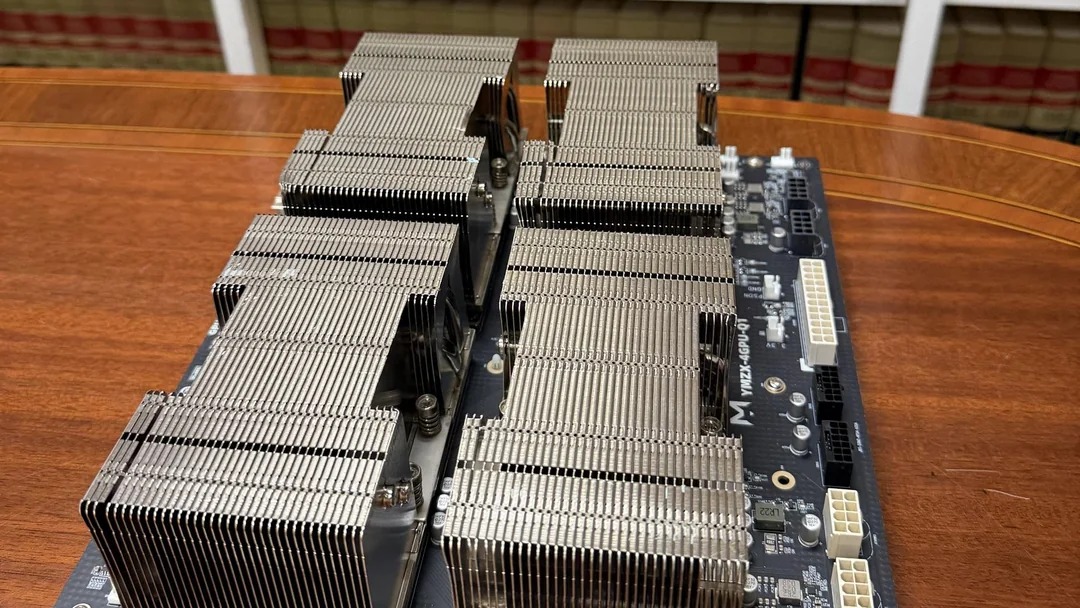
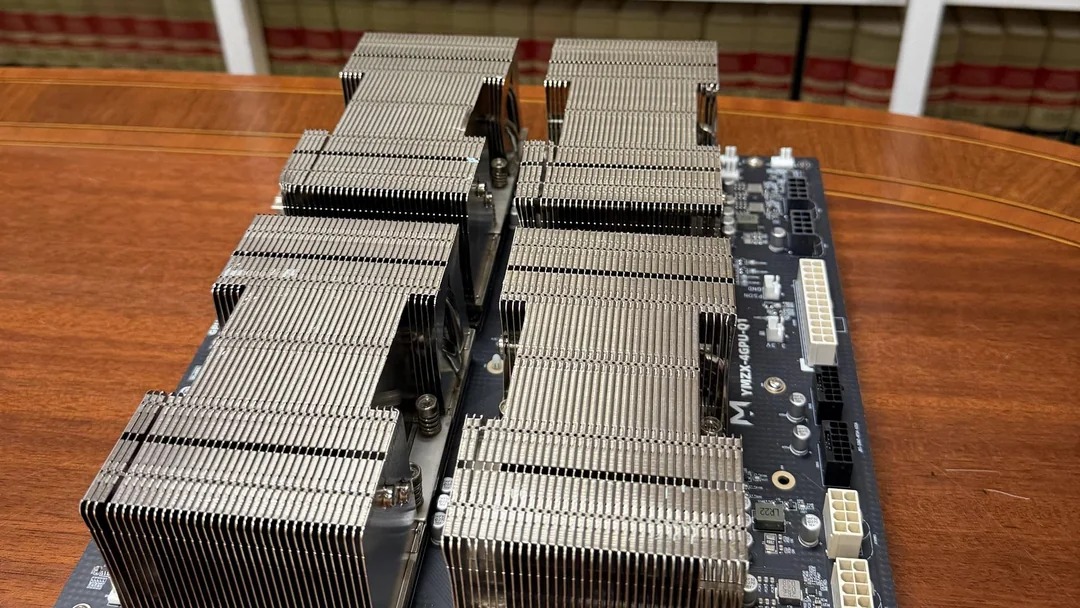
The recent story of a lawyer who built an eight-V100 server in his office to keep case files offline is a perfect case study. He wasn’t just looking for a way to process legal documents, he was solving a privacy problem with a sledgehammer. His rig, two 4-card SXM2 NVLink boards, four PEX switches, and SlimSAS cables everywhere, runs DeepSeek V4.1 Flash at up to 215 tokens per second, keeping sensitive client data entirely off the cloud.
But look closer at the details in his build thread: He had a burnt power connector. He had ECC memory errors that vanished only when he dropped from DDR4-3200 to DDR4-2666. He had a GPU stuck at x4 instead of x8. The host reset twice with fatal PCIe errors.
The Physics Problem: 3,000 Watts in a Bedroom
The most striking technical hurdle in this space isn’t software, it’s thermodynamics. An 8x 3090 rig running flat out can pull over 2,400W. You’re not plugging that into a surge protector. You’re calling an electrician.
One Reddit builder who posted his finished rig details the setup: eight Gigabyte Gaming OC 3090s on a Romed8-2t motherboard, all flashed to 270W power limits and water-cooled because there is physically no space for air coolers between the cards. Power comes from two power supplies, an AX1600i and an HX1500i, split between motherboard and GPU groups.
The idle draw is 300W. Three hundred watts just to sit there and breathe.
For context, that’s roughly the power draw of a window AC unit running on high. And this isn’t the data center, this is a desk in a home office or a shelf in a basement. It’s a winter heater that occasionally computes a 70B parameter model.
Water Cooling: The Ultimate Engineering Flex
Air cooling 8 GPUs stacked on risers is a fool’s errand. The lawyer’s V100s came as SXM2 modules, mezzanine cards that plug into a baseboard, which are designed to be water-cooled or blasted by a jet of air in a server chassis. But the 3090 builders have to retrofit.
The water loop becomes the centerpiece of the build. It’s a puzzle of fittings, flow rates, and thermal capacity. How many radiators do you need to dissipate 2,400W of continuous heat? The answer is usually “more than you think”, and it involves 360mm rads stacked like a lifeguard’s chair.
This is where the “engineering statement” element really shines. Building the loop is genuinely difficult. It requires planning the runs to avoid kinking, choosing the right pump head for the resistance of eight water blocks, and bleeding the system of air bubbles for hours. A completed loop is a badge of honor. A loop with clear tubing and colored coolant is a personality.
The Motherboard Auctions and the PCIe Lane Tax
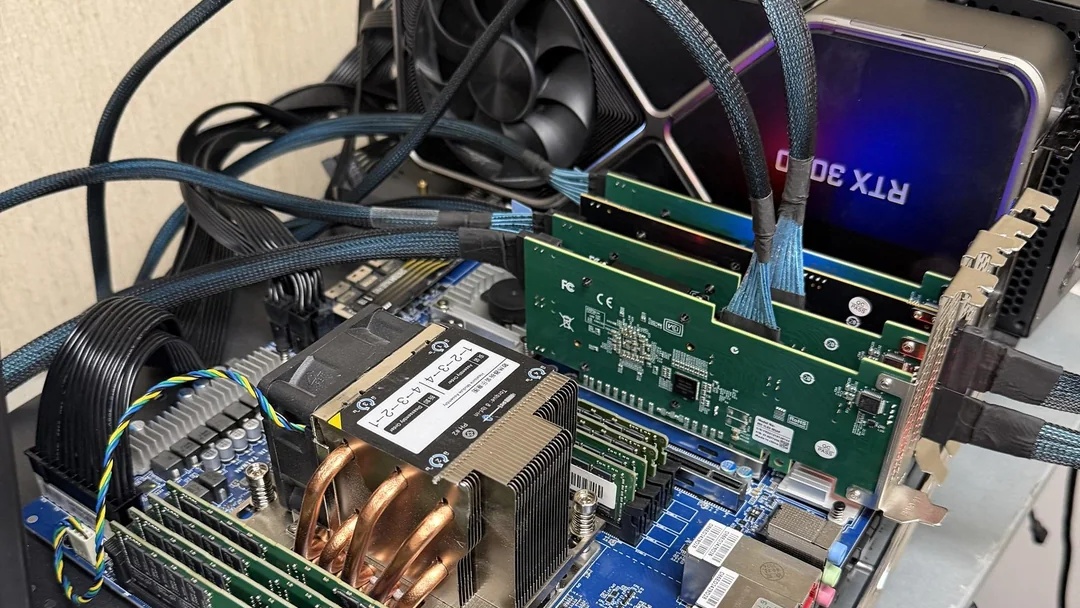
Beyond cooling, there’s the small matter of actually getting eight GPUs to talk to one CPU. Consumer boards top out at four slots before you hit lane limits. So the community pivots to server boards, the Romed8-2t, the WRX80, or whatever used EPYC/Threadripper board is flooding the market this quarter.
The PCIe lane arithmetic is brutal. On the lawyer’s board, all eight V100s run at PCIe 3.0 x8, with every board connecting via two PEX switches over SlimSAS. But if you’re using 3090s, you need PCIe 4.0 to get full bandwidth, and x8 is the best you’ll get for most of them. The two “rightmost” GPUs on the Romed8 often share one slot, dropping to x8 each to make the math work.
The builder in the Reddit thread reports that with modified Nvidia drivers enabling P2P traffic, he measures 22GB/s between GPUs, except for the ones stuck at x8. That hurts. A 3090 is theoretically capable of 32GB/s per direction on PCIe 4.0 x16. Halving that for two cards in a shared slot is a real bottleneck for tensor parallelism.
The Inflation of Used Hardware
There’s a dark side to this hobby that’s accelereng: the economics are inverted.
Used V100 32GB SXM2 cards that sold for ~$400 apiece earlier in 2026 are now listed on eBay at ~$900, more than double. The CMP-170HX volatility glitch has driven those prices from $2,500 to over $4,000 in a matter of days.
This isn’t just supply and demand, it’s speculation. The DIY AI community became a leading indicator for the broader AI hardware market. When a card gets discovered as “good for LLMs”, the arbitrage closes within the week.
The Performance That Drives It
Despite the pain, the payoff is real. The lawyer’s build achieves 215 tokens/s on code with DeepSeek V4.1 Flash (compressed to 2-bit), and 118 tokens/s on legal writing. The QA in the comments notes that “only 60 tok/s” from an 8x 3090 rig seems low, and there’s a thread about what quant was being used, but 60 tok/s with 10 parallel agents is actually solid.
The real benefit is memory bandwidth. Eight 3090s give you 192GB of VRAM. Eight V100s give you 256GB. That’s enough to load models that cost hundreds of thousands of dollars to rent per month from the cloud. And because the data never leaves the building, it’s the ultimate compliance machine for regulated industries.
| Prompt length | Wait for first token | Code (tokens/s) | Legal writing (tokens/s) |
|---|---|---|---|
| 1K tokens | 1.2 seconds | 215 | 118 |
| 32K tokens | 17.2 seconds | 200 | 117 |
| 128K tokens | 59.2 seconds | 183 | 111 |
| 256K tokens | 118.7 seconds | 160 | 103 |
Look at that table. The degradation from 1K to 256K tokens is graceful, a 25% drop in generation speed while the model ingests a quarter-million-token context. That’s a legitimate capability that cloud APIs either don’t offer or charge astronomical prices for.
A Subculture on the Edge
The DIY AI rig is a snapshot of a specific moment. It’s built on the assumption that GPU prices won’t stay low, that driver support will eventually die, and that the hardware you bought today will be worthless tomorrow. The lawyer’s V100s are on borrowed time, the Nvidia R580 driver branch is the last to support Volta, and once that ends, the ecosystem evaporates.
Yet the builds persist. More are being posted every week. The community keeps finding new hacks, from voltage glitching to unlock fuses to soft-mods that bypass AI throttle rates. And every build is a statement: “I will not be locked into the cloud. I will not rent compute. I will build my own, and I will accept the electrical bill.”
The 8x GPU water-cooled behemoth is the hot rod of the AI age. It’s inefficient, it’s impractical, and it’s glorious. It says more about the builder than about the hardware. And in a world where AI capability is increasingly gated by capital gatekeepers, the rogue builders are proving that the frontier is still open, if you’re willing to bleed a radiator for it.