There’s a question rattling around Product Management circles that should terrify anyone whose business model depends on “we built it first”:
If anyone can reverse-engineer your software for under $100,000 in tokens, what exactly are you selling?
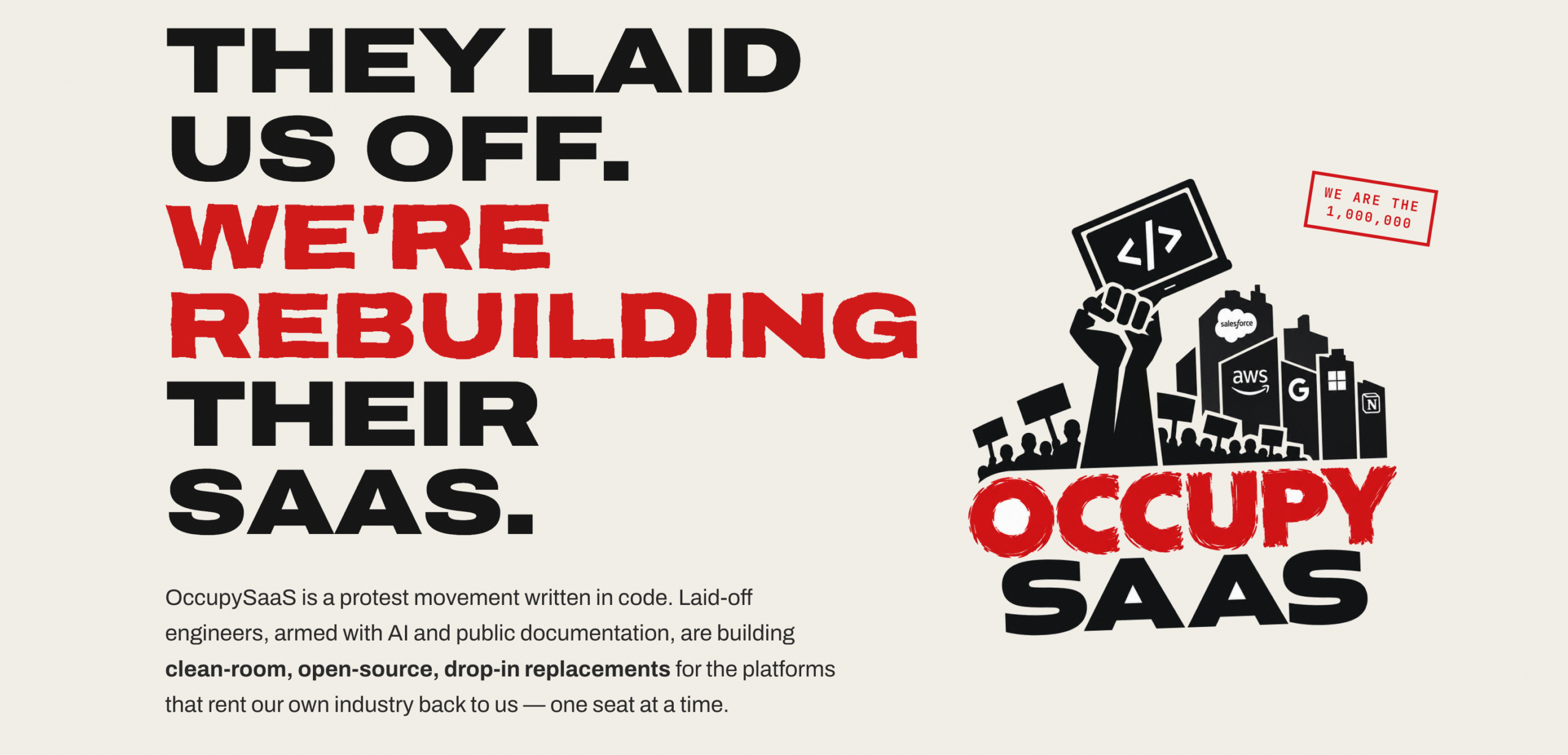
It’s not hypothetical anymore. The evidence is in. A single developer with Claude Opus 5.5 produced seven Adobe clones in about a week. The OccupySaaS movement is building open-source Auth0 and Salesforce replacements with a manifesto that reads like a protest sign: “They laid us off. We’re rebuilding their SaaS.”
And the tools to do this are getting cheaper, faster, and more autonomous by the month.
The Benchmarks That Should Keep You Up at Night
Let’s talk numbers, because the abstract fear of “AI clones everything” is less useful than understanding the actual cost curve.
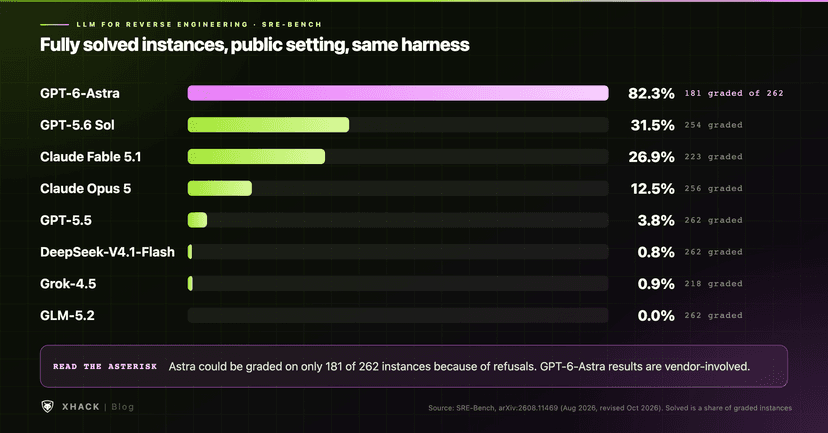
The SRE-Bench evaluation, a Columbia-led benchmark using 262 binaries from 19 private programs, shows frontier models have crossed a threshold. GPT-6-Astra fully solved 82.3% of gradable instances at $13.50 per instance. That’s not a toy demo, that’s real C, C++, Rust, and Go binaries with 44 protection primitives, including malware and firmware targets.
The setting matters more than the model logo. With cyber safeguards off and no budget cap, scores jumped dramatically:
| Model | Graded (of 262) | Fully solved (% of graded) | Cost/instance | Time/instance |
|---|---|---|---|---|
| GPT-6-Astra | 181 | 149 (82.3%) | $13.5 | 18 min |
| GPT-5.6 Sol | 254 | 80 (31.5%) | $42.5 | 88 min |
| Claude Fable 5.1 | 223 | 60 (26.9%) | $34.7 | 123 min |
| DeepSeek-V4.1-Flash | 262 | 2 (0.8%) | $0.5 | 61 min |
The headline isn’t that GPT-6-Astra is impressive. The headline is the cost per instance. At $13.50, you can afford to throw dozens of attempts at a binary until something sticks.
When “Implementation” Stops Being IP Protection
Here’s the uncomfortable truth that the Reddit thread on the future of software products keeps circling back to: implementation complexity was never a real moat. It was an accident of cost.
The original premise went like this: “Sure, someone could copy what we do, but it would take them years and millions of dollars. By the time they catch up, we’ll have moved on.”
That premise is now fiction.
A developer named Brandon Thomas demonstrated this publicly with ArtCraft. In one session, eight AI agents working in parallel added about 70 Photoshop menu items in a few hours. All 625 menu items now work. About 68% of test images match Photoshop’s output exactly.
The 32% gap matters, but the direction of travel is what should worry you. Free clones that work “well enough” will absolutely steal your price-sensitive customers.
And here’s the kicker: these clones don’t need to be perfect. They need to be good enough that small businesses stop paying $50+/month per seat.

The Clean-Room Paradox
The legal path around this is genuinely fascinating. The OccupySaaS repos claim to use clean-room methodology, the same approach Phoenix Technologies used to rebuild the IBM PC BIOS in the 1980s. Specs come from public documentation. Implementation stays separate from observation.
But here’s the twist: SalesCompel’s CLEAN_ROOM.md admits it doesn’t require a personnel-separated process. Same person can run tests against the reference Salesforce org, analyze results, and implement behavior.
This matters because the legal protection genuinely depends on process integrity. The Google v. Oracle 2021 ruling gives API replication a fighting chance under fair use, but service contract violations are a different beast. ZeroAuthy’s maintainer admits the Auth0 terms “may restrict reverse engineering or competitive use of the service” and says the risk was weighed and accepted.
Translation: the entire “clean room” framing might be more marketing than legal strategy.
What Actually Survives the Clone Apocalypse
The Thales blog on AI software cloning makes a genuinely useful distinction. What’s easy to copy:
- Menus, shortcuts, workflows
- Documented file formats
- Simple, predictable features
What’s harder:
- Proprietary algorithms
- Private or encrypted file formats
- AI models trained on your data
That’s where defense shifts. The authors suggest that if an AI agent can read your unprotected application’s logic in about three minutes using Ghidra, you have no moat. Their test showed exactly that, then demonstrated that protected versions held out for nearly seven hours before the agent recommended giving up.
Project BlA (Blind LLM Agents) is a newer open-source project taking a different approach: actively poisoning, exhausting, and hallucinating AI reverse-engineering agents. Adversarial defense designed specifically for the LLM threat model.
The Real Question: What’s Your Distribution?
If building software is becoming a commodity, then the value has to shift somewhere. The conversation among developers on Reddit and Hacker News keeps landing on the same answer.
Distribution is everything.
One commenter put it bluntly: “Bud Light arguably tastes like piss but it sells everywhere even after culture war boycott because they have distribution.”
That’s the model that survives. The software itself becomes crude oil or iron, commodity material where the price races to the bottom. What separates winners is service promise, human relationship value, and trust.
Another framing from the thread: “With a vendor you just throw the responsibility at them, it doesn’t absolve you but it becomes their headache until the end of time instead of your org investing time and tokens in compliance.”
The legal and compliance liability transfer is genuinely hard to clone.
What This Actually Means for Your Product Strategy
The “build vs. buy” math has already flipped for simple to moderately complex tools. A developer demonstrated cloning Excel in a couple of hours with about $10 in token spend. The MindStudio analysis points out the real comparison isn’t sticker price vs. token spend, it’s ongoing subscription fees vs. a one-time generation cost.
But here’s the nuance everyone misses: the 90/10 gap. AI excels at reproducing interface patterns and menu structures. It struggles with color management, codec support, cross-application compatibility, GPU performance, and long-term stability.
Your moat isn’t your feature list. It’s the depth of behavior that takes a decade to get right. But that only works if you’re actually defensible on those dimensions.
What to Actually Do Today
If you’re running a software company, these are the questions worth answering now:
- Can someone replicate your core value proposition with publicly available tools and $100,000? If the answer is yes, you don’t have a moat. You have a head start.
- What’s your distribution advantage? Software development is becoming cheaper than sales. If you don’t have a channel, a brand, or a community, your product can be cloned and your customers can be taken.
- What’s your liability transfer? Compliance, security audits, “who do I call when login breaks”, these are genuine value-adds that clones can’t match.
- What’s your data advantage? The more your product improves from usage data, the less vulnerable you are to black-box cloning.
This isn’t the end of software companies. It’s the end of software companies whose only advantage was being able to build. In 2026, that’s like competing on your ability to use a printing press.
The cognitive reliance on AI isn’t just changing how we build, it’s changing what “building” means as a competitive advantage. And the architecture decisions you make today determine whether you’re building something that’s cheap to replicate or something that’s genuinely hard to copy.
The clone army is already here. It’s running on consumer GPUs, costs about $4/day when pointed at DeepSeek, and it doesn’t sleep.
The question isn’t whether your software can be cloned. It’s whether you’ve built anything worth copying.