On September 8, 2026, OpenAI published a blog post with a headline that would have sounded like science fiction a decade ago: a group of 10,000 autonomous AI agents, powered by an internal model “significantly more capable than GPT-6 Astra”, had produced a solution to the Navier-Stokes existence and smoothness problem.
One of the seven Millennium Prize Problems, each carrying a $1 million bounty and a permanent place in mathematical history, had fallen to a server rack. The proof itself is 165 pages. The purported timeline is 88 hours. The compute cost is estimated at around $15 million.
And the whole thing has already devolved into one of the messiest credit disputes in modern mathematics.
The mathematics is genuinely historic. But the story of how OpenAI got there, and who deserves acknowledgment, is where the plot thickens.
What the Problem Actually Is
Before we dive into the controversy, let’s get the math straight. The Navier-Stokes equations, first formulated in the 19th century by Claude-Louis Navier and George Gabriel Stokes, describe how fluids move using Newton’s second law. They’re the mathematical backbone of aircraft design, weather forecasting, and blood flow modeling (learn more about fluid dynamics applications).
The Millennium Prize version asks a deceptively simple question: can smooth three-dimensional fluid motion develop a “singularity”, a point where the velocity becomes unbounded in finite time, even with viscosity constantly working to smooth things out?
The Clay Mathematics Institute posed this problem in 2000 as one of seven challenge questions. In 1934, Jean Leray proved existence of weak solutions, but the question of whether they remain smooth indefinitely became the mathematical equivalent of “is the universe consistent?”
OpenAI’s claim: yes, singularities can form. An initially smooth fluid at rest, subjected to a smooth external force, can develop finite-time blowup while maintaining finite energy. The official post states this resolves statements “C” and “D” from the official Millennium Prize formulation.
The physical interpretation matters here. A singularity, where velocities blow up to infinity, means the continuum approximation breaks down. The equations stop describing reality. As Venkat Chandrasekaran of OpenAI put it: “This problem has remained unsolved for 200 years because the Navier-Stokes equations are just so enormously complex, and the pen-and-paper calculations you need to do in order to solve this problem are just mind-bogglingly intricate.”
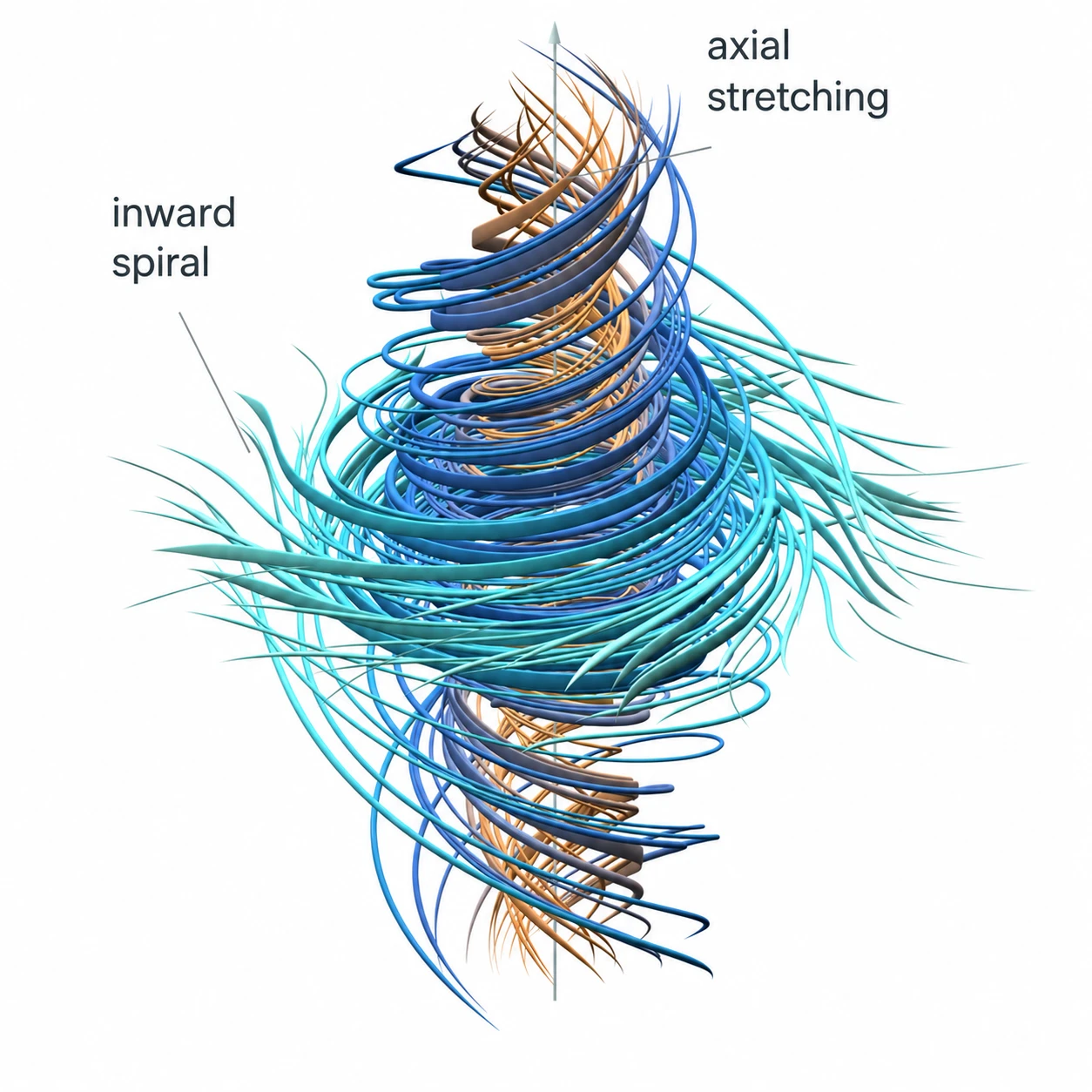
The proof describes a specific construction: a vortex that spirals inward, stretches like spaghetti, and accelerates into a singularity. The terms in the equations, acceleration, pressure gradients, momentum transfer, and viscosity, each become singular yet cancel in precise ways, leaving a smooth external force while the velocity itself diverges. This isn’t just “we found a counterexample by hand”, it requires exquisitely delicate balance mathematics.
The Agentic Army That Did the Work
Let me put the scale of this operation in perspective. According to Quanta Magazine, the effort began August 28 with intensive training of a new internal OpenAI model. On September 1, the company heard rumors that researchers had cracked Millennium Prize problems using AI. That’s when things escalated.
The agent orchestration looks like this:
- Approximately 100 agents spent 50 hours solving the unforced Euler regularity problem first, a related but simpler question where viscosity is literally absent
- Once that succeeded, OpenAI redirected resources to the full Navier-Stokes problem
- Up to 10,000 concurrent agents attacked the problem from different angles
- By September 5, only 88 hours after launching, the Navier-Stokes resolution emerged
- GPT-6 Astra spent 17 additional hours performing Lean formalization and verification
The agent infrastructure involved “cached internet access, code execution capabilities, and group-based communication.” Different agent groups were fed different variants of the problem statement, versions A/B (which would require existence proofs) versus C/D (which would suggest singularities). Codex was used to consolidate insights from different groups and cross-pollinate them.
The token economy is frankly staggering: across all attempted problems, agents sent 4.9 million messages and consumed 300 billion output tokens. The Navier-Stokes effort alone required 2.7 million messages and 130 billion tokens.
Here’s where my skepticism kicks in, and it’s the same skepticism voiced across developer forums and Reddit. The claim “10,000 agents working for 88 hours” needs decomposition. Were all agents independent explorers? Or were most, say 9,900, performing routine simulation and verification tasks while a core cluster handled actual proof architecture? The phrasing “on the order of 10,000 concurrent agents” deliberately blurs this distinction. Calling it a “swarm” carries impressive marketing energy, but the research acceleration perspective is more nuanced.
What I find genuinely interesting is how the approach mirrors human research teams. The OpenAI researchers described their coordination role as “like a bumble bee cross-pollinating across different groups and delivering different bits of information.” That’s leadership, not automation.
The Formalization Advantage (and Its Limits)
One critical detail: the proof was formally verified in Lean, an interactive theorem prover. This isn’t optional rigor, it’s transformative rigor.
Traditional proofs in analysis are notorious for hidden assumptions. Grad students spend months checking whether that “obvious” limit swap actually holds. Lean eliminates this entire category of error by requiring every step to be logically justified. The project file repository shows formal definitions, proof scripts, and lemmas in explicit machine-checkable form.
However, there’s a limit to what Lean verification accomplishes. As Quanta notes, formal verification in Lean establishes that a statement follows from its premises. But someone must still ensure the Lean formalization “is logically equivalent to what mathematicians set out to prove.” This is the infamous “semantic gap” problem: the theorem might be formally correct while not meaning what you think it means.
And despite these results, Terence Tao has expressed reservations about AI-driven mathematics eroding the field’s pedagogical value. He compared AI assistance to lifting weights, the struggle itself builds understanding. Machines can verify and generate, but they can’t teach a generation of mathematicians why certain approaches work.
The Controversy: Who Actually Owns This?
Now we get to the part that explains the blog post’s title.
Twelve hours before OpenAI’s announcement, NYU mathematician Tristan Buckmaster and Anthropic researcher Levent Alpöge published findings on related “forced Euler equations” problems. They’d been working on this for over a year, using both Anthropic models and OpenAI’s Codex for code generation.
The timeline is telling:
- August 22: Buckmaster and Alpöge complete a Lean-verified proof for the Euler equations
- They plan to polish their write-up before publishing
- Word of their progress leaks to OpenAI
- September 1: OpenAI launches its own effort after hearing “rumors” that two Millennium Prize problems had been resolved
OpenAI freely admits that its effort began after hearing these rumors. The company reached out to Buckmaster and Alpöge with a proposed joint announcement, after already completing their own proof and Lean verification. OpenAI says they recognize priority for the forced Euler result but claim novel territory for Navier-Stokes.
Buckmaster isn’t buying it.
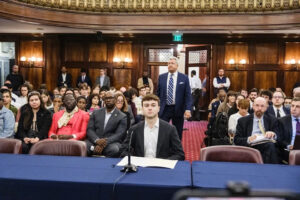
In a statement on his website, Buckmaster said OpenAI accelerated its work after learning they were close to publication. He noted that the duo’s work-in-progress was stored in OpenAI’s Codex, raising questions about whether model training data might have absorbed their unpublished approaches. When he threatened to publicize the dispute, allegedly, OpenAI researcher Sébastien Bubeck responded: “Why would you ruin your career?”
The Nuance Buckmaster himself provides is crucial: “I do not know what their model did, or how. I do not know whether our data was used. I am not accusing anyone of anything.”
What’s undeniable is the uncomfortable alignment. The World Economic Forum published a scathing assessment of OpenAI’s behavior in this affair. The structural question that Axios posed is even more important: what happens when the platform scientists use to do research can simultaneously compete against them with vastly greater resources? This episode raises the core trust question for AI-assisted science, whether researchers can safely use frontier labs’ tools for unpublished discoveries.
Was there data leakage? OpenAI admits “we cannot rule out that de-identified data derived from their usage of our products helped improve our models.” That admission alone should give any researcher pause about storing unpublished work in competitor infrastructure.
The Deeper Pattern: AI Agents Are Getting Astonishingly Good at Math
Let’s zoom out. This Navier-Stokes result isn’t isolated. It comes after a summer where:
- OpenAI’s Astra model generated solutions to 10 longstanding mathematical problems with verified proofs
- Fermat’s Last Theorem was formalized by AI agents in just 11 days
- Multiple Erdős problems fell to AI-assisted attacks
- The efficiency race in AI models has moved from benchmark chasing to actual discovery
The progression is accelerating: from AI as proof-checker to AI as proof-generator to AI as proof-inventor. Erdős problems are falling to AI at a pace that troubles some mathematicians.
Charles Fefferman of Princeton, who wrote the Clay Institute’s official problem description, suggests the intellectual debt here belongs to Diego Córdoba and Luis Martínez-Zoroa. Their 2021 analytical techniques for constructing singularity solutions, an “infinite cascade” approach, provided the foundation upon which both teams’ AI proofs build. “Ten years ago, nobody believed there was a singularity for Navier-Stokes”, Córdoba recalled. The field shifted after the 2013 Hou-Luo cylinder breakthrough, which showed Euler blowup in bounded domains.
The AI result accomplishes what the analysis community had been chipping away at for a decade, but it needed enormous compute and novel architecture to close the gap on smooth forcing functions.
The Economic Fork in the Road
Here’s a more uncomfortable question that New Scientist surfaced: if a customer wanted to replicate this entire run, OpenAI quoted roughly $15 million.
Let’s put that in context. $15 million for an 88-hour run equals about $170,000 per hour. For comparison, professional mathematicians working decades on Navier-Stokes have consumed perhaps millions of person-hours. The compute-to-human labor ratio has inverted in ways that were unthinkable even last year.
OpenAI claims it won’t pursue the $1 million prize. Considering they dropped $15 million in compute, this is less noble than it sounds. As one Reddit commenter noted, claiming the prize to reimburse themselves might be more amusing than admirable.
The cost structure raises fundamental questions about who can do frontier math in the age of AI. If solving a Millennium Prize problem requires a $15 million compute allocation, the only players are massively funded AI labs racing toward AGI. Independent researchers, brilliant grad students, and public universities are priced out entirely.
What This Means for the Future of Mathematical Research
Let me be the voice of measured (or maybe not-so-measured) optimism.
The Navier-Stokes proof, if it holds up, demonstrates something profound about AI agent orchestration. The division of labor, exploration, simulation, proof search, formalization, verification, reveals a template for how multi-agent systems can tackle superhuman intellectual challenges. This 10,000-agent army did in 88 hours what the brightest humans couldn’t crack in 90 years. That’s not a “competitor”, that’s a new form of mathematical instrument.
Agentic swarming is becoming a major architectural pattern in software development. What OpenAI demonstrated here isn’t just “a big model can do math”, it’s that coordinated specialized agents with shared context can generate, refine, and verify intricate arguments at scale.
But here’s the critical caveat: no one know why the proof works.
When humans prove theorems, they develop intuition. They understand which argumentative approaches succeed and why. GPT-6 Astra didn’t “decide” to use Córdoba’s technique because it understood the underlying philosophy, it likely explored millions of branches and succeeded on one guided path. As Opposite-Grade3712 noted in the Reddit thread: “if the solution isn’t valuable just because it was generated by a black box that got lucky, then the problem wasn’t actually important in the first place.” Fair point. Mathematics is about truths, not about the human satisfaction of discovery.
Yet the “understanding gap” matters for what Nobel-winner Phil Anderson called “more is different.” The techniques that solved Navier-Stokes may generalize to unsolved problems, or might be narrowly scoped black-box outputs that provide no transferable intuition. The failure mode isn’t the proof being wrong, it’s the proof being opaque.
This is where the AI math resurrection arc gets dark. As Terence Tao–the rare Fields Medalist who wrote about these concerns–pointed out, “machines can solve the problems, but they can’t pass on the insight.” Whether we’re entering a golden era of AI discovery or an era of crescent-shaped incomprehensibility depends on how we extract knowledge from these systems (as this analysis of AI math systems wonders).
The discipline developing around formal verification in Lean as a standard output format might be our hedge. The proof is checkable by humans. The knowledge encoded in those logical steps is acquirable. We might not understand the full search path, but we can at least understand the destination.
The Verdict: Historic, Contested, and Unresolved
This episode owes its drama to an unusual trifecta, an amazing mathematical result, a wild AI architecture story, and a legitimate credit dispute that will be debated for years. It’s worth noting that the Lean verification happened in 17 hours via GPT-6 Astra, the previously released model. The internal model remains unreleased, and OpenAI is keeping the “next-GPT” cards close to its chest, which is precisely what makes its claims unverifiable and its competitive tendencies harder to scrutinize.
The Wall Street Journal reports that the company seems to hit a new capability frontier every month. The $1 trillion IPO valuation narrative becomes suddenly plausible when your AI models can generate million-dollar mathematical breakthroughs as a benchmark exercise.
Where does this leave mathematicians? Partly thrilled, partly terrified, partly suing. As the Theorem walks toward formalization, the boundary between “math done by humans” and “math done with machines” blurs beyond repair.
What we’re witnessing isn’t just AI solving math problems. It’s AI rewriting what it means to do mathematics at all. The next 90 years might not have any unsolved Millennium problems left to contemplate.
Just don’t expect the credit settlement for this one to be resolved before the next breakthrough drops.