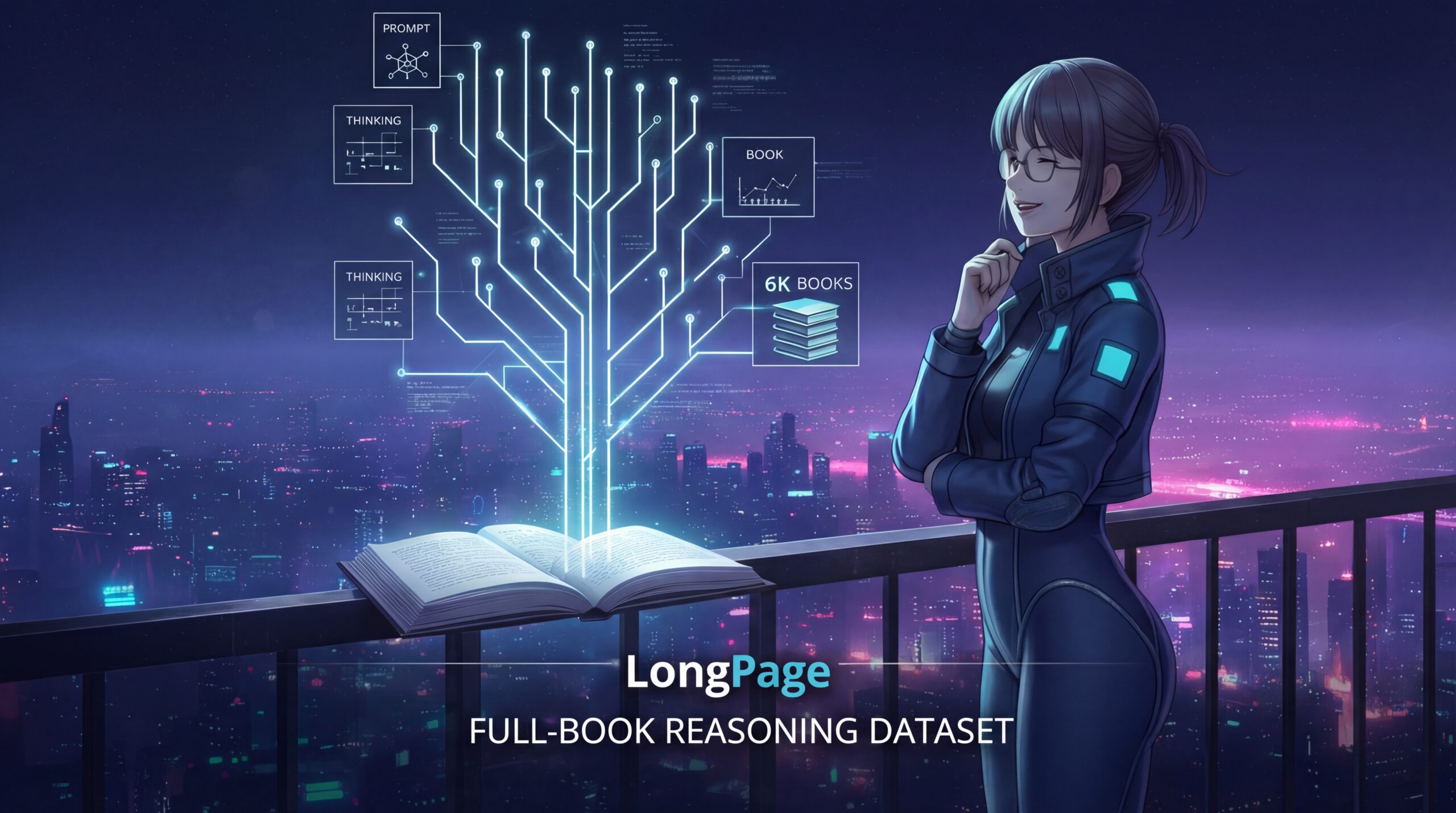
The problem with AI writing has never been the prose, it’s the architecture. Anyone can prompt a model to churn out a decent paragraph. Getting one to sustain a 400-page novel with consistent characters, interwoven arcs, and thematic coherence? That’s been the wall. Pageshift just released a wrecking ball: 6,000+ full-length novels paired with hierarchical reasoning traces, a dataset that exposes the entire decision-making stack behind long-form storytelling.
This isn’t another pile of text. LongPage is a surgical dissection of how narratives are built, from the ground up.
The 20x Expansion That Changes Everything
The previous release of LongPage contained a modest 300 books. The new update jumps to 6,067 novels, a 20-fold increase that signals something bigger than scale. It’s a statement: the era of short-context creative writing is over. These aren’t snippets or chapters, they’re complete works ranging from 40,000 to over 600,000 tokens, spanning novellas to epic series that would break most current context windows.
But the raw size is the least interesting part. What makes LongPage potentially transformative is its hierarchical reasoning architecture, a multi-layered planning trace that breaks each book into a cognitive roadmap: character archetypes, story arcs, world rules, scene-by-scene breakdowns, and embedding-space analytics that quantify pacing, dialogue density, and exposition flow.
Think of it as giving AI the director’s commentary, storyboard, and shooting script, not just the final film.
How to Reverse-Engineer a Novel: The Two-Stage Pipeline
Pageshift didn’t just scrape Project Gutenberg and call it a day. They built a two-stage processing pipeline that reads like a masterclass in data engineering at scale.
Stage 1: The Agentic Seed Set (300 Books)
They started with the top 300 most-downloaded public-domain titles. For each book, they ran an agentic multi-prompt pipeline powered by Qwen3-32B with reasoning enabled. This wasn’t a single-shot summary, it was an iterative, self-checking process that climbed the narrative ladder:
-
Scene Level: Segment chapters into scenes using rule-based cues (time/place/POV changes), validated by LLM when ambiguous. For each scene, compute an embedding space across seven dimensions:
action,dialog,world_building,exposition,romantic,erotic,pacing. Each value is the mean of 16 Qwen3 inferences, thresholded to 0 if below 10. -
Chapter Level: Distill scene summaries into chapter summaries, generate a chapter-specific writing style profile, and aggregate scene embeddings into chapter-level metrics.
-
Book Level: Compose chapter summaries into story arcs, extract world rules (deviations from modern reality), identify character archetypes for main and side characters, merge style notes into a book-level writing profile, and generate a concise book archetype label.
-
Synthetic Metadata: Finally, produce a synthetic title, tags, a non-spoiler highlight, and, crucially, a user prompt (5-700 words) designed for SFT/inference scaffolding. These prompts vary by structure, tone, persona, and length to create a diverse training distribution.
The result? A rich JSON object per book with nested hierarchies that preserve narrative structure. Here’s the schema:
{
  "book_title": "Synthetic Title",
  "book_highlight": "Non-spoiler summary",
  "book_tags": ["Psychological Horror", "Weird Fiction"],
  "book_archetype": "Weird Fiction (strong), Psychological Horror",
  "world_rules": ["Supernatural forces are real", "Isolation amplifies paranoia"],
  "story_arcs": ["Arc 1: The Shorthouse Chronicles", "Arc 2: Unsettling Encounters"],
  "character_archetypes": {
    "Shorthouse": ["Adventurer and Investigator", "Skeptical companion"]
  },
  "book_chapters": {
    "THE EMPTY HOUSE": {
      "chapter_summary": ["Bulleted summary points"],
      "embedding_space": {"action": 0, "dialog": 40, "pacing": 54},
      "scene_breakdown": [
        {
          "scene_name": "Nature of Haunted Houses",
          "scene_summary_short": ["Bulleted scene points"],
          "embedding_space": {"world_building": 41, "exposition": 79}
        }
      ]
    }
  }
}
Stage 2: Distilled Scale (5,700 Books)
Processing 6,000 books with an agentic loop would be computationally suicidal. So Pageshift distilled the pipeline into specialized tool models:
- A scene-level tool model (Qwen3-14B) that segments chapters and computes embeddings in one shot.
- A chapter-level tool model that aggregates scenes into chapter summaries and style profiles.
- A book-level tool model that synthesizes arcs, world rules, and character archetypes.
- A prompt/metadata model that generates synthetic titles, tags, and training prompts.
Each tool model was fine-tuned on the Stage 1 outputs using supervised fine-tuning with token-level cross-entropy. The result: a one-shot pipeline that preserves the Stage 1 schema while processing books at scale. The synthetic traces are, in essence, LLM-labeled data for training other LLMs, a recursive approach that’s becoming standard in the post-scarcity data era.
What Controversy Looks Like in 2026
Let’s address the elephant in the room: this dataset is synthetic all the way down. The reasoning traces weren’t written by human annotators, they were generated by Qwen3-32B. The titles are synthetic. The prompts are synthetic. Even the book archetype labels are synthetic.
This raises a thicket of questions:
-
Quality Drift: If you train a model on synthetic data generated by another model, do you get compounding errors or emergent simplifications? Pageshift claims the tool models preserve the original schema and thresholding behavior, but the community will need to validate this rigorously.
-
Copyright Ambiguity: The source texts are public domain from Project Gutenberg, but the synthetic traces are licensed under CC-BY-4.0. If you train a model on this dataset, what’s the legal status of the reasoning patterns it learns? This is uncharted territory.
-
The Worm Problem: One Reddit user asked if the dataset includes Worm by Wildbow. The answer was no, only Project Gutenberg. This highlights a cultural limitation: the canon is old. You’re training on 19th and early 20th-century prose, which means modern narrative techniques, diverse voices, and contemporary genre conventions are underrepresented. The model might learn to write a convincing Dickens pastiche but struggle with a nonlinear cyberpunk thriller.
-
Evaluation Leakage: Many of these public-domain books appear in other corpora. If your benchmark includes, say, Pride and Prejudice, you’re effectively testing on training data. Pageshift warns about this explicitly, but it’s a systemic problem in LLM research.
The Token Economics of Novel-Writing
The dataset includes visualizations that tell a stark story about computational cost. The stacked token composition chart shows that for the longest books, the “thinking” scaffold (orange) can rival or exceed the raw book text (green) in token count. A 600,000-token epic might require another 600,000 tokens of hierarchical metadata.
This isn’t just a storage problem, it’s a training-time cost bomb. Fine-tuning on this dataset means processing not just the books but the entire reasoning trace for every gradient step. Pageshift’s approach enables curriculum learning (train on book-level plans first, then chapter expansions, then scene completion), but the compute budget is staggering.
The book length histogram reveals another challenge: a long tail of massive works. Most books cluster around 100k-200k tokens, but a small fraction stretches past 500k. These outliers can dominate batch processing and create memory bottlenecks. If you’re training on this, you’re either dropping the longest works or investing in serious infrastructure.
From Dataset to Model: The Inference Implications
Pageshift is already training a full-book writing model on LongPage. Early checkpoints are running internally, and they plan to release when quality hits an “acceptable level.” The architecture is explicitly designed for cold-start SFT → RL workflows with a three-component structure: prompt, thinking, and book.
This means the model isn’t a chatbot. It’s more like an image generation model for text: you feed it a prompt, and it returns a complete, planned, written novel. The hierarchical traces serve as Chain of Thought for creative writing, a scaffold the model can learn to generate internally before committing to prose.
Imagine the prompt: “Write a psychological horror about a journalist investigating a haunted house where a stableman murdered a servant.” The model would first generate the entire reasoning trace, world rules, character archetypes, three-act structure, scene-level pacing notes, and then use that as a blueprint to write the actual chapters. This is planning-before-execution at a scale LLMs have never attempted.
The Real Controversy: Who Owns the Writing Process?
Here’s what’s actually radical: LongPage externalizes the entire creative stack. Traditional writing is opaque: authors plan, outline, revise, and scrap in private. Even when they share process, it’s selective. This dataset makes the process legible, quantifiable, and cloneable.
Every narrative decision, why a scene is 76% exposition vs. 40% dialogue, why a character follows the “Sage” archetype, why the pacing spikes in Chapter 7, is encoded as structured data. This isn’t just training data, it’s a reverse-engineered creative mind.
The implications ripple beyond AI. If you can quantify what makes a story “work”, you can optimize it. You can A/B test narrative arcs. You can calibrate emotional beats to maximize engagement. This is the industrialization of storytelling, and LongPage is the first assembly line.
The Limits of Synthetic Mastery
Pageshift is admirably transparent about limitations. The dataset is English-only. It strips formatting and front/back matter. It contains historical violence, slurs, and outdated stereotypes without filtering. The synthetic traces have no span-level grounding, you can’t trace a specific sentence back to its source in the original text.
Most critically: the reasoning traces are not human. They’re generated by a model that itself has no lived experience, no intuition, no subconscious. The hierarchical plans are impressive simulations, but they’re simulations nonetheless. You’re teaching a model to mimic the structure of thought without the substance.
The Bottom Line
LongPage is a technical achievement that’s impossible to ignore. The two-stage pipeline is elegant. The hierarchical schema is comprehensive. The scale is serious. For researchers building long-context models, this is a goldmine.
But it’s also a mirror. It reflects what we think storytelling is: a set of quantifiable components that can be decomposed, labeled, and recomposed. If that’s true, then yes, AI will write novels as well as humans, maybe better. If it’s false, then we’ve built a sophisticated mimic that captures the shape of creativity without its spark.
Either way, the dataset is out. The models are training. The next few months will show whether hierarchical reasoning traces are the breakthrough they promise, or just another way to generate very long, very coherent, very empty prose.
The question isn’t whether AI can write a novel. It’s whether we’ve just taught it to write the wrong ones.
Follow Pageshift’s journey on their website, Hugging Face, or Twitter. The LongPage dataset is available here.