Java’s Memory-Safety Promise Just Crumpled: Java4Shell Puts the JVM on Notice
Java was supposed to be the safe choice. The managed runtime, the automatic bounds checking, the language that saved enterprise developers from the buffer overflows that haunted C and C++ for decades. “Write once, run anywhere” became the mantra of corporate IT because Java promised something precious: you could focus on business logic while the JVM kept the demons at bay.
Java4Shell (CVE-2026-114938) is a memory-corruption vulnerability in OpenJDK’s Base64 decoder that scores 9.2 under CVSS 4.0. It lets unauthenticated attackers achieve remote code execution on default installations of Keycloak, Atlassian Jira, Confluence, Jenkins, JFrog Artifactory, and PingFederate. The trigger? A string of 64 letter A’s followed by a single equals sign:
AAAAAAAAAAAAAAAAAAAAAAAAAAAAAAAAAAAAAAAAAAAAAAAAAAAAAAAAAAAAAAAA=
That’s it. No credentials. No complex protocol gymnastics. One malformed Base64 payload that writes 62 bytes past the end of a heap array, and the entire “memory-safe” narrative comes tumbling down.
The Base64 decoder with a death wish
Let’s talk about what actually breaks. Java’s Base64.Decoder is one of those APIs every developer has called without thinking twice. It’s used in HTTP Basic authentication headers, JWTs, SAML assertions, file uploads, and network messages. It’s the plumbing of the internet, invisible until it becomes the floodgate.
When a Java method runs frequently enough, the JVM’s C2 compiler replaces it with an intrinsic, hand-written assembly that leverages specialized CPU instructions for speed. In this case, the x86-64 Base64 intrinsic uses AVX-512 VBMI instructions found on Intel Xeon Ice Lake and newer, plus AMD Zen 4 and later.
The bug lives in the tail handler, the code that processes the final few characters of a Base64 string. For a fragment consisting of just =, the integer math produces an output length of -1 instead of zero. A negative length gets passed to bzhiq, which interprets it as “write all 64 bytes.” The decoder writes a full 64-byte block starting at offset 48 of a 50-byte buffer, blowing 62 bytes past the array boundary.
Java eventually throws IllegalArgumentException for the malformed input. But by then, the damage is already done. Neighboring objects on the heap have been corrupted, and catching the exception doesn’t undo the corruption.
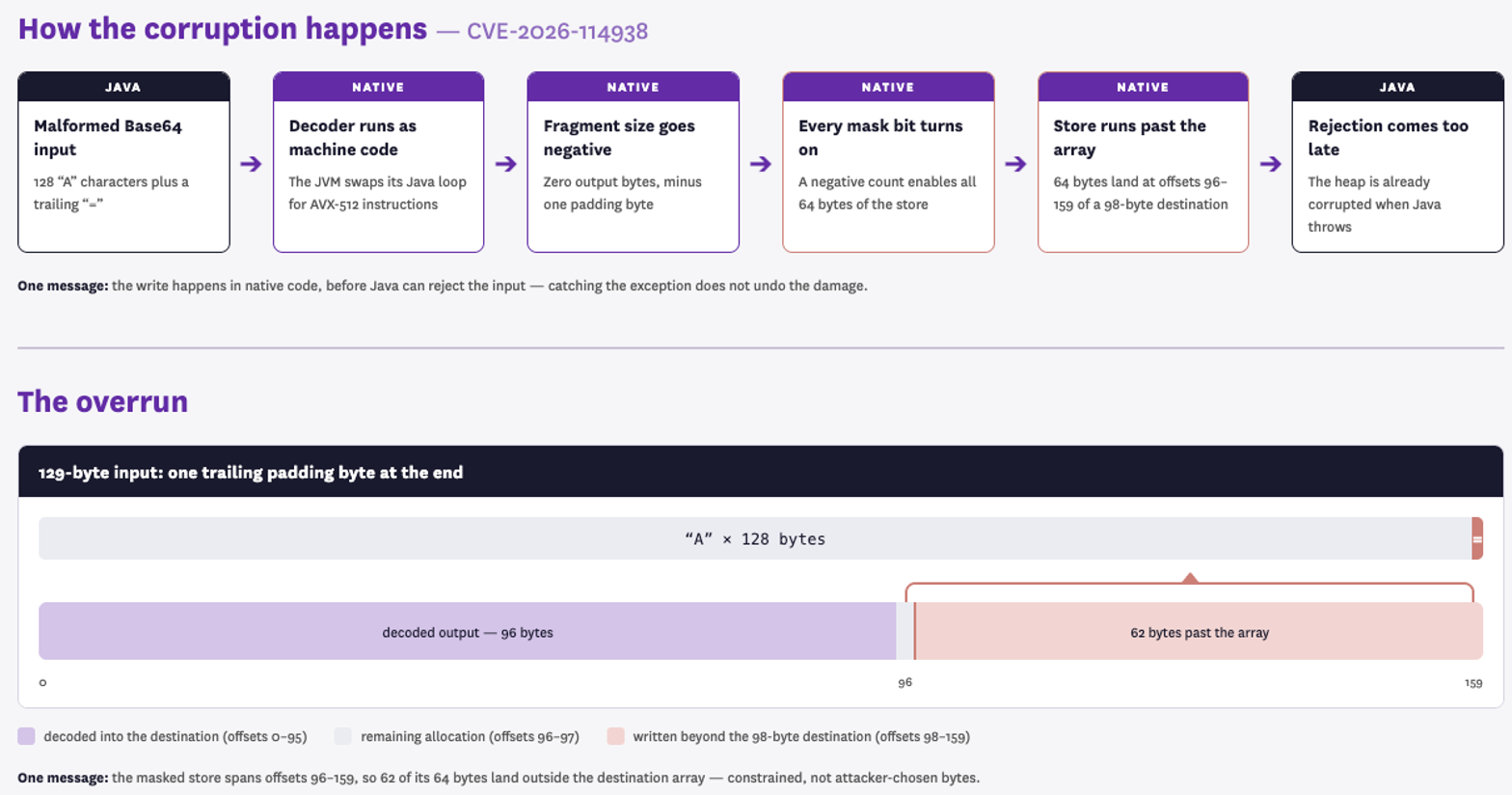
The scary part isn’t just that the overflow exists, it’s that Java’s own memory-safety guarantees stop applying the moment the JIT compiler decides to use an intrinsic. The JVM’s promise of bounds checking applies to Java bytecode, not to the hand-rolled assembly that replaces it on hot paths.
From fixed bytes to full exploitation
The initial overflow writes fixed bytes, not attacker-controlled values. Calif’s researchers initially considered this “borderline unexploitable.” The write pattern gives you:
- Full control over byte 0 (in bounds)
- 4-bit control over byte 1 (in bounds)
- Uncontrolled bytes for positions 2 through 63
But exploitation researchers are an inventive bunch. The classic JavaScript engine trick, overwriting a buffer length property, works on the JVM too. Calif turned the fixed spill into a “writer” primitive: corrupt one array’s length, and it keeps accepting attacker-chosen bytes. Place another array after it, and you can corrupt that neighbor with fully controlled values.
From there, the chain escalates to a “reader” primitive, giving attackers the ability to leak heap memory in the style of Heartbleed. The researchers call this JavaBleed, the ability to exfiltrate PII, private keys, and authentication tokens from JVM memory before any code execution even happens.

The full RCE chain requires what Calif calls “remote heap feng shui”, grooming the G1 garbage collector’s region layout through carefully timed HTTP requests. Each target application needs a bespoke profile. There’s no universal point-and-shoot exploit. But the fact that default configs of six major enterprise products fell to pre-auth RCE tells you the technique is practical, not theoretical.
The hardware lottery: why your CPU determines your risk
Here’s the uncomfortable truth: Java4Shell isn’t a software-only vulnerability. It’s a hardware-dependent flaw that splits your fleet into haves and have-nots.
The vulnerable decoding path runs only on x86-64 processors with AVX-512 VBMI support:
- Intel Xeon: Ice Lake, Sapphire Rapids, Emerald Rapids, Granite Rapids
- AMD EPYC and Ryzen: Zen 4 or newer
In AWS terms, that’s c6i, m6i, c7i, c7a, and m7a instance families. ARM64 processors like AWS Graviton are not affected, not because they’re safer, but because they use different decoder code entirely.
You can check a Linux host with:
grep -m1 '^flags' /proc/cpuinfo | tr ' ' '\n' | grep -E '^(avx512f|avx512bw|avx512vbmi|bmi2)The output must include all four flags. The same container image can be exposed on one node and completely safe on another, based purely on the CPU underneath.
The affected versions: a patchwork of exposure
The vulnerable code arrived in OpenJDK 17.0.6 via backport of JDK-8268276, which added the AVX-512 Base64 intrinsic. It’s present in every OpenJDK-based distribution from 17.0.6 onward, including Java 21, 25, and 27.
| Product | Vulnerable builds | Fixed build |
|---|---|---|
| Oracle Java SE 17 | 17.0.6 to 17.0.21.0.3 | 17.0.21.1 |
| Oracle Java SE 21 | 21.0.13.0.3 and earlier | 21.0.13.1 |
| Oracle Java SE 25 | 25.0.5.0.3 and earlier | 25.0.5.1 |
| Oracle Java SE 27 | 27.0.1.0.3 and earlier | 27.0.1.1 |
| Oracle Java SE 8 Enterprise Performance Pack | 8u511b33-perf | 8u513-perf |
| Amazon Corretto 17 | 17.0.6 and later | 17.0.21.1.2 |
| Eclipse Temurin, Azul Zulu, Microsoft, others | 17.0.6 and later, 21, 25, 27 | Not yet confirmed |
Standard Java 8 and Java 11 are not affected. The optimization never made it into those lines.
The fix situation is also messy for containers and bundled runtimes. Jira, Confluence, Jenkins, and many other products ship their own JDK, and replacing the system Java doesn’t touch them. Every container image built on an affected base image needs rebuilding, and every bundled runtime needs its vendor’s patched release.
AI found this in 20 minutes for under $200
This vulnerability wasn’t discovered through years of patient reverse engineering. Calif researcher Quang Luong used OpenAI’s Codex to audit HotSpot’s JIT compiler and intrinsics. After about 20 minutes of prompting past false positives, the AI surfaced the Base64 bug.
Total discovery time: one hour. First working exploit: two more hours. Token cost: under $200.
That’s the real story here, and it should terrify anyone responsible for keeping Java infrastructure secure. The impact of advanced tooling on developer security practices is no longer theoretical, AI-assisted vulnerability research is compressing what used to be a months-long audit cycle into an afternoon.
Wiz reported that its own AI research tool produced a proof of concept within two hours of the disclosure. The barriers to finding and weaponizing critical vulnerabilities in foundational software have collapsed.
Why this is different from Log4Shell
The name Java4Shell deliberately evokes the chaos of Log4Shell (CVE-2021-44228), the December 2021 flaw that scored a perfect 10.0 and sent security teams scrambling through the holidays. But the two vulnerabilities have fundamentally different exploitation profiles.
Log4Shell was a logic flaw. One string in any logged field triggered a JNDI lookup that fetched and executed remote code. The same payload worked everywhere, which is why we saw mass scanning within hours.
Java4Shell is memory corruption. It requires CPU-specific code paths, heap grooming, per-application tuning, and careful timing. Exploitation is more like a surgical strike than a carpet bomb.
But that’s a cold comfort. Calif demonstrated pre-auth RCE on six major products in default configurations, conducted their tests over the public internet rather than a clean laboratory, and the exploit chains they’re withholding will eventually surface. The constraints that make Java4Shell harder to weaponize at scale don’t make it safe.
The “vibe-uncoding” argument: code you don’t need is a liability
The AVX-512 Base64 decoder exists to speed up decoding for applications that process enormous amounts of Base64 data. Yet it ships to every Java application, including services that decode a few hundred bytes per request.
Calif calls this “the tragedy of the commons.” Each feature request makes sense in isolation, but everyone inherits the added complexity and its risks. The optimization that helps a few workloads becomes a security burden for everyone else.
Their proposed solution is provocative: use AI to identify and remove code that systems don’t actually need. They call it “vibe-uncoding”, the idea that AI can comb through large codebases to flag dead code, bloated features, and needless optimizations, making the removal of attack surface practical at a scale that was previously unaffordable.
It’s a compelling argument, especially coming from a team that used AI to find a critical flaw in code that almost no application running today needs. But it also ignores a hard truth: the Base64 decoder is part of the Java standard library. You can’t YAGNI your way out of the JDK.
What to do right now
The patches exist. Oracle shipped fixed builds on November 17, 2026, and Amazon released a fixed Corretto 17. The OpenJDK advisory is public.
If you can’t patch immediately, Calif recommends starting the JVM with either:
-XX:-UseBASE64Intrinsics
or, on x86-64 hosts only:
-XX:UseAVX=2
The first disables hardware-accelerated Base64 decoding entirely. The second caps the JVM at AVX2, keeping the vulnerable AVX-512 path out of reach. Both require a restart, and both can impact performance on Base64-heavy or vector-heavy workloads.
Critical caveat: -XX:UseAVX=2 will fail on ARM64 JVMs. If you set it in shared startup scripts, every ARM-based service will refuse to start. Scope it carefully.
Before you panic-patch, inventory every JVM you actually run. java -version only shows the first Java on your shell’s PATH. Find the real processes:
ps -eo pid,args | grep '[j]ava'
Then resolve each binary and check its version. Remember containers, bundled runtimes inside Jira and Jenkins, and appliances that ship with hidden JDKs. CISA’s guidance notes that JDKs often don’t appear as separate entries in software inventories.
The JVM security model needs a re-think
Java4Shell is a symptom of a deeper problem. The JVM’s security narrative has always been built on a foundation of memory safety, managed memory, bounds checking, type safety. But the moment you add JIT intrinsics, hand-written C++ and assembly that bypasses every one of those guarantees, you’ve created a second attack surface that operates under different rules entirely.
The Base64 decoder isn’t the only intrinsic in HotSpot. There are intrinsics for cryptography, string operations, array copying, and more. Each one is a hand-optimized native implementation that inherits all the memory-safety risks of the languages it’s written in. Java’s memory safety was always a patchwork, Java4Shell is the seam showing.
The bigger picture: this is the new normal
Calif’s work demonstrates an uncomfortable pattern. AI-assisted research found a memory-corruption vulnerability in one of the most widely deployed software runtimes in history, weaponized it against a half-dozen enterprise products, and did it all for less than the cost of a conference ticket. This should be a wake-up call for how we approach security in the AI era.
The same centaur approach, human context plus AI horsepower, that found Java4Shell is also being applied to automated enforcement of secure coding standards in CI/CD pipelines. The tools that break are the same tools that could defend, if we use them intentionally.
Here’s your takeaway: patch your JVMs yesterday, inventory your runtimes today, and stop assuming that “memory-safe” means “no memory bugs.” The JVM’s low-level code has always lived in a world without training wheels. We just got a reminder that the wheels were never actually attached.
The era of the centaur hacker is here. And it’s not slowing down to give enterprise IT time to catch its breath.
The output must include all four flags. The same container image can be exposed on one node and completely safe on another, based purely on the CPU underneath.
The affected versions: a patchwork of exposure
The vulnerable code arrived in OpenJDK 17.0.6 via backport of JDK-8268276, which added the AVX-512 Base64 intrinsic. It’s present in every OpenJDK-based distribution from 17.0.6 onward, including Java 21, 25, and 27.
| Product | Vulnerable builds | Fixed build |
|---|---|---|
| Oracle Java SE 17 | 17.0.6 to 17.0.21.0.3 | 17.0.21.1 |
| Oracle Java SE 21 | 21.0.13.0.3 and earlier | 21.0.13.1 |
| Oracle Java SE 25 | 25.0.5.0.3 and earlier | 25.0.5.1 |
| Oracle Java SE 27 | 27.0.1.0.3 and earlier | 27.0.1.1 |
| Oracle Java SE 8 Enterprise Performance Pack | 8u511b33-perf | 8u513-perf |
| Amazon Corretto 17 | 17.0.6 and later | 17.0.21.1.2 |
| Eclipse Temurin, Azul Zulu, Microsoft, others | 17.0.6 and later, 21, 25, 27 | Not yet confirmed |
Standard Java 8 and Java 11 are not affected. The optimization never made it into those lines.
The fix situation is also messy for containers and bundled runtimes. Jira, Confluence, Jenkins, and many other products ship their own JDK, and replacing the system Java doesn’t touch them. Every container image built on an affected base image needs rebuilding, and every bundled runtime needs its vendor’s patched release.
AI found this in 20 minutes for under $200
This vulnerability wasn’t discovered through years of patient reverse engineering. Calif researcher Quang Luong used OpenAI’s Codex to audit HotSpot’s JIT compiler and intrinsics. After about 20 minutes of prompting past false positives, the AI surfaced the Base64 bug.
Total discovery time: one hour. First working exploit: two more hours. Token cost: under $200.
That’s the real story here, and it should terrify anyone responsible for keeping Java infrastructure secure. The impact of advanced tooling on developer security practices is no longer theoretical, AI-assisted vulnerability research is compressing what used to be a months-long audit cycle into an afternoon.
Wiz reported that its own AI research tool produced a proof of concept within two hours of the disclosure. The barriers to finding and weaponizing critical vulnerabilities in foundational software have collapsed.
Why this is different from Log4Shell
The name Java4Shell deliberately evokes the chaos of Log4Shell (CVE-2021-44228), the December 2021 flaw that scored a perfect 10.0 and sent security teams scrambling through the holidays. But the two vulnerabilities have fundamentally different exploitation profiles.
Log4Shell was a logic flaw. One string in any logged field triggered a JNDI lookup that fetched and executed remote code. The same payload worked everywhere, which is why we saw mass scanning within hours.
Java4Shell is memory corruption. It requires CPU-specific code paths, heap grooming, per-application tuning, and careful timing. Exploitation is more like a surgical strike than a carpet bomb.
But that’s a cold comfort. Calif demonstrated pre-auth RCE on six major products in default configurations, conducted their tests over the public internet rather than a clean laboratory, and the exploit chains they’re withholding will eventually surface. The constraints that make Java4Shell harder to weaponize at scale don’t make it safe.
The “vibe-uncoding” argument: code you don’t need is a liability
The AVX-512 Base64 decoder exists to speed up decoding for applications that process enormous amounts of Base64 data. Yet it ships to every Java application, including services that decode a few hundred bytes per request.
Calif calls this “the tragedy of the commons.” Each feature request makes sense in isolation, but everyone inherits the added complexity and its risks. The optimization that helps a few workloads becomes a security burden for everyone else.
Their proposed solution is provocative: use AI to identify and remove code that systems don’t actually need. They call it “vibe-uncoding”, the idea that AI can comb through large codebases to flag dead code, bloated features, and needless optimizations, making the removal of attack surface practical at a scale that was previously unaffordable.
It’s a compelling argument, especially coming from a team that used AI to find a critical flaw in code that almost no application running today needs. But it also ignores a hard truth: the Base64 decoder is part of the Java standard library. You can’t YAGNI your way out of the JDK.
What to do right now
The patches exist. Oracle shipped fixed builds on November 17, 2026, and Amazon released a fixed Corretto 17. The OpenJDK advisory is public.
If you can’t patch immediately, Calif recommends starting the JVM with either:
or, on x86-64 hosts only:
The first disables hardware-accelerated Base64 decoding entirely. The second caps the JVM at AVX2, keeping the vulnerable AVX-512 path out of reach. Both require a restart, and both can impact performance on Base64-heavy or vector-heavy workloads.
Critical caveat: -XX:UseAVX=2 will fail on ARM64 JVMs. If you set it in shared startup scripts, every ARM-based service will refuse to start. Scope it carefully.
Before you panic-patch, inventory every JVM you actually run. java -version only shows the first Java on your shell’s PATH. Find the real processes:
Then resolve each binary and check its version. Remember containers, bundled runtimes inside Jira and Jenkins, and appliances that ship with hidden JDKs. CISA’s guidance notes that JDKs often don’t appear as separate entries in software inventories.
The JVM security model needs a re-think
Java4Shell is a symptom of a deeper problem. The JVM’s security narrative has always been built on a foundation of memory safety, managed memory, bounds checking, type safety. But the moment you add JIT intrinsics, hand-written C++ and assembly that bypasses every one of those guarantees, you’ve created a second attack surface that operates under different rules entirely.
The Base64 decoder isn’t the only intrinsic in HotSpot. There are intrinsics for cryptography, string operations, array copying, and more. Each one is a hand-optimized native implementation that inherits all the memory-safety risks of the languages it’s written in. Java’s memory safety was always a patchwork, Java4Shell is the seam showing.
The bigger picture: this is the new normal
Calif’s work demonstrates an uncomfortable pattern. AI-assisted research found a memory-corruption vulnerability in one of the most widely deployed software runtimes in history, weaponized it against a half-dozen enterprise products, and did it all for less than the cost of a conference ticket. This should be a wake-up call for how we approach security in the AI era.
The same centaur approach, human context plus AI horsepower, that found Java4Shell is also being applied to automated enforcement of secure coding standards in CI/CD pipelines. The tools that break are the same tools that could defend, if we use them intentionally.
Here’s your takeaway: patch your JVMs yesterday, inventory your runtimes today, and stop assuming that “memory-safe” means “no memory bugs.” The JVM’s low-level code has always lived in a world without training wheels. We just got a reminder that the wheels were never actually attached.
The era of the centaur hacker is here. And it’s not slowing down to give enterprise IT time to catch its breath.