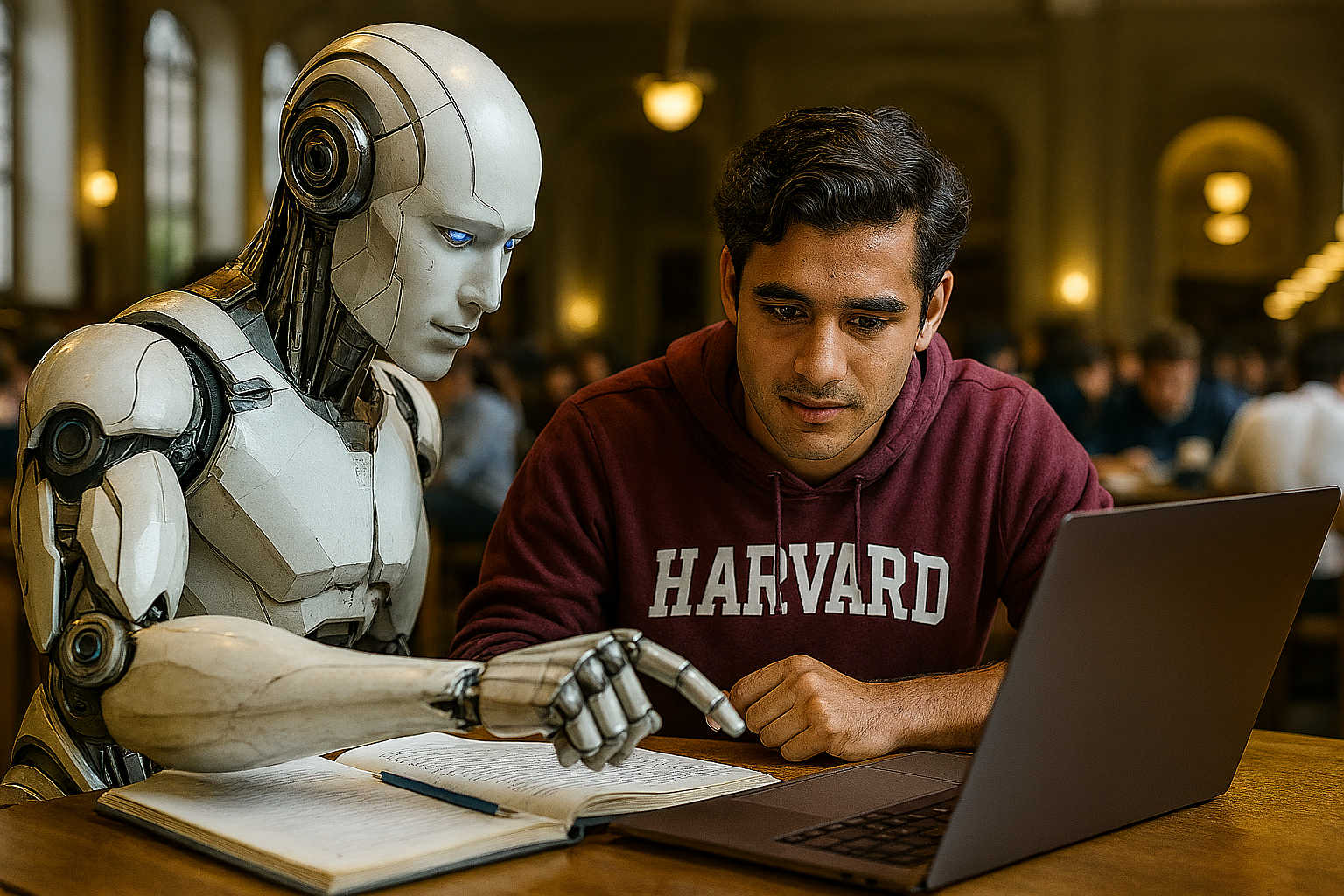
The numbers are almost too good to be true. In a randomized controlled trial published in Nature Scientific Reports last June, Harvard researchers showed that AI tutors didn’t just match active learning classrooms, they more than doubled learning gains while requiring less time and boosting student engagement. For anyone tracking AI’s impact on education, this should be a watershed moment. The technology works. The pedagogy scales. The results are peer-reviewed.
But here’s what keeps getting lost in the excitement: 87% of students in high-income countries have home internet access. In low-income countries, that number is 6%. While the AI tutoring market explodes across North America, Europe, and Asia-Pacific, the regions that need educational transformation most urgently are structurally locked out. We’re not witnessing the democratization of learning, we’re watching the foundation of a two-tiered education system get poured in real-time.
The Study That Changes Everything
Let’s start with what Harvard actually proved, because the methodology matters. This wasn’t a glorified ChatGPT homework helper. The research team engineered an AI tutor specifically designed around pedagogical best practices that human teachers simply cannot deliver at scale:
- Scaffolding: Breaking complex physics problems into manageable steps, adjusting difficulty in real-time based on student performance
- Cognitive load management: Presenting information in digestible chunks to prevent overwhelm
- Immediate personalized feedback: Zero wait time between mistake and correction, with explanations tailored to each student’s specific misconception
- Self-pacing: No student gets dragged ahead before mastering a concept, and no student gets held back by the median classroom speed
The trial involved 194 physics students split between AI tutoring and active learning classrooms, not passive lectures, but the current gold standard of collaborative, hands-on pedagogy. The AI group didn’t just win, they dominated. More than double the learning gains, completed in less time, with higher reported motivation.
This is the kind of teaching that every educator aspires to deliver. It’s also the kind that collapses under the weight of reality: one teacher, thirty kids, fixed schedules, standardized pacing.
The 44 Million Person Problem
While Harvard was validating AI tutors, UNESCO dropped a parallel bombshell. Their Global Teacher Report projects 44 million additional teachers needed by 2030 to achieve universal basic education. Sub-Saharan Africa alone needs 15 million. The funding isn’t there. The humans aren’t there. The infrastructure isn’t there.
Enter AI tutors with their infinite patience, infinite personalization, and near-zero marginal cost. On paper, it’s a perfect solution to an impossible problem. A digital teaching corps that scales instantly, speaks every language, and never burns out.
But paper solutions have a habit of ignoring physical reality. 2.6 billion people globally remain offline. Not “slow internet” or “spotty connectivity”, completely offline. The AI tutoring revolution requires the one resource that’s least equitably distributed on the planet: reliable internet access.
The Geography of Disconnection
The numbers reveal a brutal geographic sorting:
| Region | Home Internet Access | Teacher Shortage | AI Tutor Market Growth |
|---|---|---|---|
| High-income countries | 87% | Manageable | Booming |
| Low-income countries | 6% | Critical | Non-existent |
This isn’t a bug in the deployment plan, it’s the entire operating system of global inequality. While Silicon Valley startups race to build ever-more-sophisticated AI tutors for students who already have access to quality education, rural villages in sub-Saharan Africa struggle to find a single qualified physics teacher, let alone a device and connection to access an AI alternative.
The uncomfortable truth is that the AI tutoring market is following the money, not the need. Investment flows where returns are guaranteed: affluent markets with existing infrastructure, paying customers, and measurable ROI. The regions facing catastrophic teacher shortages are precisely where market-based solutions fail.
When “Free” Still Costs Too Much
Some argue that cost isn’t the barrier. After all, a student could cycle through free AI models, when one hits its limit, copy the conversation to the next. At $20 per month (or $0 with enough free tiers), AI tutoring is cheaper than textbooks, let alone private human tutors.
But this calculus assumes the entire cost is monetary. It ignores:
– Device access: A smartphone or computer
– Reliable electricity: To charge that device
– Digital literacy: To navigate AI interfaces effectively
– Time and space: A safe environment to study uninterrupted
– Language support: AI tutors that speak local languages and dialects
For a student in a low-income region, these aren’t trivial barriers, they’re insurmountable walls. The “free” AI tutor is trapped behind a paywall of infrastructure that costs far more than the subscription itself.
The Two-Tier Education System Taking Shape
The real controversy isn’t whether AI tutors work. The controversy is what happens next.
We’re rapidly heading toward a bifurcated system:
Tier 1 (High-income regions): Students get both AI tutors and human teachers. The AI handles personalization, practice, and immediate feedback. Human teachers focus on mentorship, complex problem-solving, and social-emotional learning. It’s a hybrid model that leverages the best of both worlds.
Tier 2 (Low-income regions): Students get neither adequate AI infrastructure nor sufficient human teachers. Overcrowded classrooms persist without technological relief, while AI tutoring remains a theoretical solution discussed in academic papers they can’t access.
This isn’t speculation. The market is already segmenting. Premium AI tutoring platforms in developed markets explicitly market themselves as supplements to quality schooling, not replacements. They’re designed for students who already have access to excellent human instruction.
Meanwhile, the “solutions” pitched for developing markets often amount to dumping low-quality, uncustomized LLMs into contexts where they fail to address local curricula, languages, or learning needs. It’s the difference between a precision-engineered teaching tool and a generic chatbot with an “education” sticker slapped on.
The Infrastructure Gap Is a Policy Choice
Here’s what gets lost in the techno-optimism: the digital divide is not a natural disaster, it’s a policy failure. We know how to build infrastructure. We’ve done it for roads, electricity, and water (imperfectly, but we’ve done it). The fact that 2.6 billion people remain offline in 2025 is a choice about where to allocate resources.
The AI tutoring breakthrough doesn’t create this inequality, it exposes and amplifies it. The technology is proven. The pedagogy is sound. The need is desperate. What’s missing is the political will to treat internet access and digital education infrastructure as fundamental public goods, not market commodities.
UNESCO’s report makes the stakes clear: without 44 million teachers, an entire generation faces educational deficits that will cascade into economic, health, and social outcomes for decades. AI tutors could close that gap, but only if we stop treating them as consumer products and start treating them as public infrastructure.
The Path Forward Isn’t Technical, It’s Political
The Harvard study gives us the blueprint. The technology exists. What we need now is:
- Massive public investment in internet infrastructure for underserved regions, treating connectivity like electricity or clean water
- Open-source AI tutoring platforms designed for offline-first deployment, with local language support and culturally relevant curricula
- Hybrid deployment models that don’t see AI as replacing teachers, but as force-multiplying limited human resources
- Regulatory frameworks that prevent AI tutoring from becoming another driver of inequality while ensuring quality control
The alternative is accepting an educational caste system where your zip code, or your country’s GDP, determines whether you get personalized AI tutoring or share a single textbook among thirty students.
The Real Lesson of the Harvard Study
The most important finding isn’t that AI tutors deliver 2x learning gains. It’s that effective pedagogy is a function of resources, not magic. The AI tutor succeeded because it could deliver what human teachers know works but can’t physically provide to thirty kids at once: immediate, personalized, scaffolded feedback.
Human teachers aren’t being replaced, they’re being asked to perform miracles with insufficient time, training, and support. AI tutors work because they finally allow proven teaching methods to scale.
But scaling requires access. And access requires confronting uncomfortable truths about global inequality, market failures, and policy priorities.
The question isn’t whether AI tutors can transform education. The question is whether we’ll let them transform it for everyone, or just for the privileged few who already have every other advantage.
The technology is ready. The need is urgent. The inequality is growing. What’s missing is the will to connect the dots.
Based on research from Kestin et al., Nature Scientific Reports (June 2025), UNESCO Global Report on Teachers (2024), and UNESCO Global Education Monitoring Report (2023). Additional context from community discussions on AI education deployment.