Google’s 2025 research output reads like a deliberate assault on the conventional wisdom that has dominated AI development for the past five years. While the rest of the industry was still racing to stack more GPUs and train larger dense models, Google was quietly dismantling the architectural assumptions that made that race necessary. The result is a trio of breakthroughs that don’t just incrementally improve AI, they fundamentally change the math behind building and deploying intelligent systems at scale.
The Gemini 3 Paradox: When Smaller Beats Bigger
The headline grabber is Gemini 3 Flash, but not for the reason you might think. Yes, it matches or exceeds Gemini 2.5 Pro on key benchmarks. Yes, it does this at “less than a quarter of the cost.” But the real story is what this means for architectural priorities.
Consider the numbers: Gemini 3 Flash scores 90.4% on GPQA Diamond and 33.7% on Humanity’s Last Exam, tests designed to measure genuine reasoning capability. It achieves this while being 3x faster than its predecessor and costing a fraction to run. This isn’t incremental optimization, it’s a fundamental shift in the efficiency curve.
The architecture behind this leap isn’t public, but the performance characteristics tell a clear story. Google has figured out how to maintain frontier-level intelligence while dramatically reducing the computational footprint. For practitioners, this means the “just use the biggest model” heuristic is now officially obsolete. The optimal model is no longer the largest one you can afford, but the most efficiently architected one for your specific latency and cost constraints.
The Sparse Revolution: KronSAE Rewrites the Compute Math
While Gemini 3 Flash grabbed headlines, the KronSAE paper published on arXiv reveals the deeper architectural shift happening under the hood. Sparse Autoencoders (SAEs) have become the go-to tool for interpreting model internals, but they’ve suffered from a fatal flaw: the encoder bottleneck.
Traditional SAEs require a dense projection into a massive dictionary space, 𝒪(Fd) operations where F is the dictionary size and d is the hidden dimension. For modern transformers, this becomes prohibitively expensive. KronSAE solves this by factorizing the latent space using Kronecker products, reducing the encoder cost to 𝒪(h(m+n)d) where h is the number of heads and m,n are factor dimensions.
The math is elegant, but the implications are radical:
# Simplified KronSAE encoder (from Appendix H)
def encode(self, x):
    acts = F.relu(x @ self.W_enc + self.b_enc)
    acts = acts.view(B, self.h, self.m + self.n)

    # Kronecker product with mAND activation
    all_scores = torch.sqrt(
        acts[...,:self.m, None] *
        acts[...,self.m:, None,:] + 1e-5
    ).view(B, -1)

    scores, indices = all_scores.topk(self.k, dim=-1)
    acts_topk = torch.zeros(
        (B, self.dict_size)
    ).scatter(-1, indices, scores)

    return acts_topk
This isn’t just a speedup, it’s a complete rethinking of how sparse representations should be constructed. The mAND activation function (modified AND) enforces a logical AND-like behavior between pre-latents, creating a compositional structure that reduces feature absorption by up to 45% compared to standard TopK SAEs.
For AI architects, this means sparse models can now be both efficient and interpretable without sacrificing reconstruction quality. The trade-off between dictionary size and compute cost has been fundamentally altered.
Infrastructure Reboot: The Age of Inference
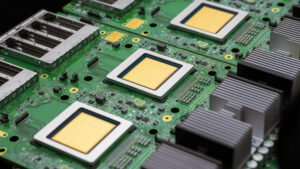
Google’s hardware story in 2025 mirrors its software evolution. The Ironwood TPU isn’t just another accelerator, it’s the first chip explicitly designed for “the age of inference”, where serving models matters more than training them.
Google Cloud’s inference stack has been rebuilt around container-first orchestration. The GKE Inference Gateway routes requests based on model identity and real-time performance signals, not just load balancing. This matters because inference workloads behave nothing like traditional web traffic, they’re bursty, latency-sensitive, and have wild variations in computational cost per request.
The numbers from production deployments are telling: 92% of developers report needing modern platforms to innovate, and teams with high platform satisfaction deploy 23% more frequently. The old pattern of “train on TPUs, figure out serving later” is dead. The new stack treats inference as a first-class citizen, with features like:
– Context caching for 90% cost reduction on repeated tokens
– Dynamic Workload Scheduler to balance accelerator utilization
– Custom compute classes for cost control under variable demand
The Selective Computation Gambit: KOSS and Context-Aware State Spaces
Perhaps the most technically profound breakthrough is KOSS, the Kalman-Optimal Selective State Space model. While Transformers struggle with quadratic complexity and Mamba relies on input-only selection, KOSS introduces a closed-loop mechanism that treats selection as a latent state uncertainty minimization problem.
The core insight is radical: instead of computing selection parameters from inputs alone, KOSS derives them from the innovation, the discrepancy between prediction and observation. This creates a context-aware selection mechanism that outperforms Mamba on long-range forecasting by 2.92, 36.23% across nine benchmarks.
The architecture is a masterclass in theoretical grounding meeting practical efficiency:
- Kalman-optimal dynamics: The gain K(t) modulates information flow based on both content and context
- Spectral Differentiation Unit: Global Fourier-based derivative estimation that acts as a “low-pass differentiator”, suppressing noise while preserving signal
- Segment-wise parallel scan: Balances hardware efficiency with modeling fidelity through tunable segment lengths
The real-world validation is compelling: on raw Secondary Surveillance Radar data with “irregular intervals, high measurement noise, and spurious returns”, KOSS maintains stable trajectory estimation while classical Kalman filters diverge and Transformers produce incoherent paths.
What This Means for Practitioners: A New Playbook
The architectural shifts Google unveiled in 2025 add up to a coherent new strategy for building AI systems:
1. Density is a Liability
Dense models are now officially legacy. Whether through sparse autoencoders, selective state spaces, or mixture-of-experts architectures, the future belongs to models that activate only what’s necessary. The compute savings aren’t marginal, they’re order-of-magnitude.
2. Inference-First Design
The entire stack, from chips (Ironwood) to orchestration (GKE Inference Gateway) to model architectures (Gemini 3 Flash), is optimized for serving, not training. If your model architecture doesn’t consider inference costs, it’s already obsolete.
3. Context-Aware > Input-Only
Mamba’s input-dependent selection was a step forward. KOSS’s context-aware selection is the next leap. Models that can’t incorporate latent state dynamics into their routing decisions will be outperformed by those that can, especially on long sequences with noise and distractors.
4. Theoretical Grounding Matters
KOSS didn’t emerge from random architecture search, it came from applying Kalman filtering principles to deep learning. As the field matures, “vibe-driven development” gives way to principled design. The most efficient architectures will be those with the strongest theoretical justification.
The Controversial Truth
Here’s what Google isn’t explicitly stating but the data makes clear: The scaling laws that defined the last era of AI are breaking down. The relationship between parameters, compute, and performance is being decoupled by architectural innovations that prioritize efficiency over brute force.
This is controversial because it undermines the business models of companies that have bet billions on the old paradigm. If a 0.2M parameter KOSS model can outperform a 1.17M parameter Transformer while using 6× less memory, what happens to the GPU hoarders? If Gemini 3 Flash delivers Pro-level performance at a quarter of the cost, what justifies the premium pricing of larger models?
The answer is increasingly: nothing. The race isn’t to who has the most compute anymore, it’s to who has the smartest architecture. Google’s 2025 research makes that abundantly clear.
For AI architects and practitioners, the message is stark: Retool or retire. The skills that mattered yesterday (model parallelism, data center optimization) are being replaced by new ones (sparse pattern design, context-aware routing, inference-first thinking). The companies that thrive will be those that recognize this shift fastest.
The rest will be left explaining why their dense, expensive, hard-to-serve models can’t compete with Google’s lean, smart, efficient alternatives. The architecture shift isn’t coming, it’s already here.