You wake up, grab your coffee, scroll X, and boom, another Chinese model dropped overnight. That’s been the rhythm of 2026, and Zhipu AI just hit the beat again with GLM-5.3. The Reddit reaction? A mix of “What a day!” and the resigned meme: i wake up → another chinese model.
But here’s the twist that makes GLM-5.3 genuinely interesting instead of just another Friday release: Zhipu didn’t retrain the base model. At all. Every single improvement comes from post-training. And in the process, they accidentally stumbled into a cybersecurity capability that’s now outpacing their coding gains.
Let’s break down what actually shipped, what’s hype, and why the two-week wait for open weights is the real story hiding under the benchmark table.
The Same 743B Base. Zero Pretraining. All Post-Training.
Let that sink in for a second. GLM-5.3 runs on the exact same 743B parameter base model as GLM-5.2. No architecture changes, no new pretraining runs, no tokenizer swaps. Just one month of scaling post-training on the stack they built for 5.2: IndexShare for long-context, SAO for RL on long-horizon tasks, and slime for large-scale asynchronous training.
This isn’t unusual in isolation, DeepSeek did something similar between its flash preview and 0731 release, and Anthropic’s Opus 4.7 reportedly did a tokenizer swap rather than a full pretrain. But the scale of gains from pure post-training is what’s turning heads. The community reaction on Reddit nailed it: “Of course it’s only post-train. I would be shocked if GLM pretrained a completely new model for a +0.1 release.”
And honestly? The results validate the approach. These aren’t marginal 2% improvements, these are massive jumps on exactly the benchmarks that matter most for real-world agentic work:
| Benchmark | GLM-5.2 | GLM-5.3 | Absolute Change | Relative Change |
|---|---|---|---|---|
| Terminal-Bench 3.0 | 4.6 | 28.3 | +23.7 points | +515.2% |
| SWE-Marathon v1.1 | 19.4 | 42.5 | +23.1 points | +119.1% |
| DeepSWE v1.1 | 46.2 | 66.9 | +20.7 points | +44.8% |
| AutomationBench v1.0.6 | 26.2 | 48.2 | +22.0 points | +84.0% |
| ExploitBench | 24.4 | 54.4 | +30.0 points | +123.0% |
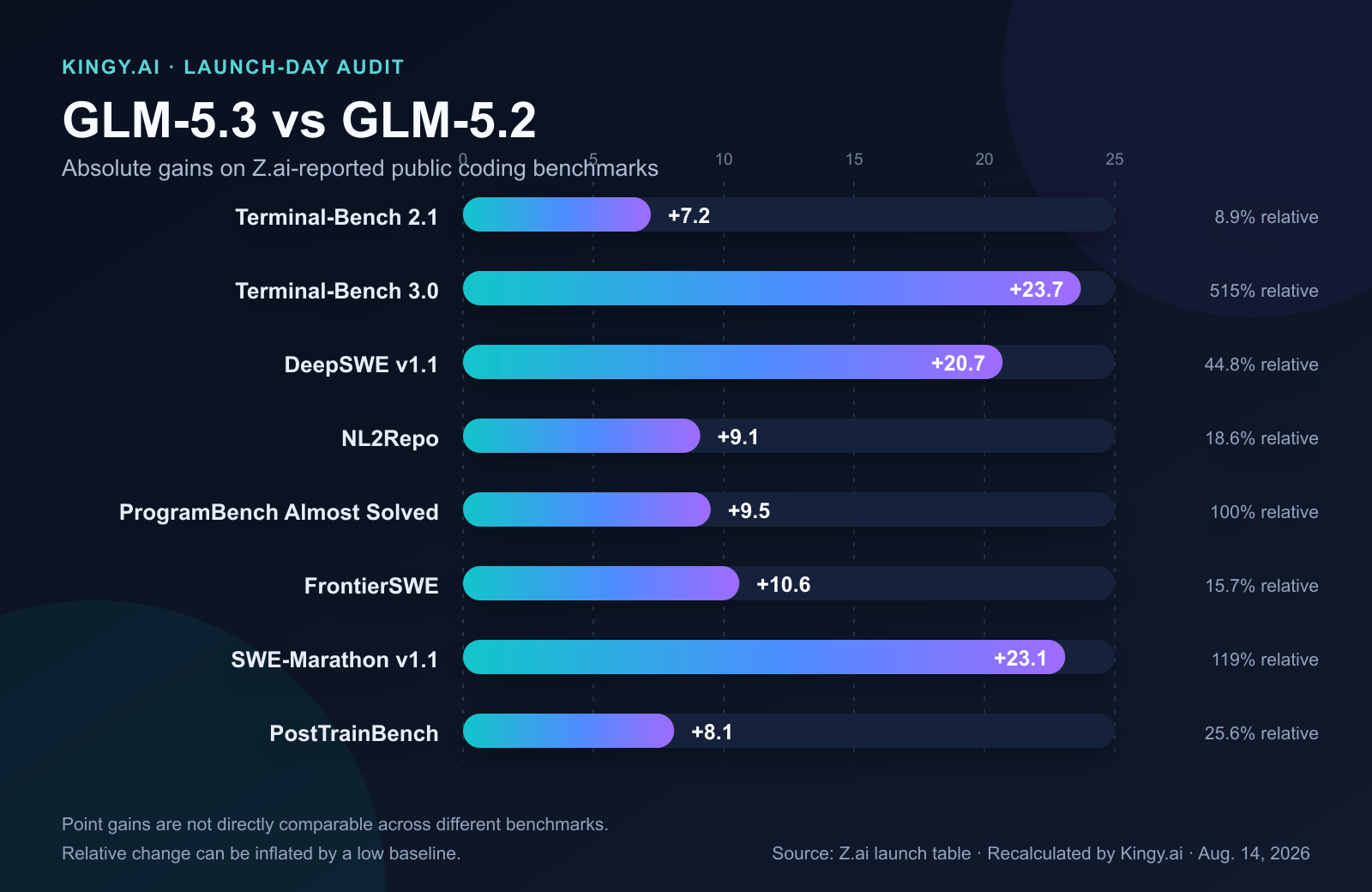
Every single benchmark Zhipu published moved in the right direction. That’s a consistent signal, even if you’re skeptical of vendor-run numbers.
“Emergent Cyber Capability” Is the Scary Part
Here’s where GLM-5.3 stops being a coding model update and becomes something more consequential.
Zhipu says they added vulnerability discovery data to the training mix expecting the model to get better at finding individual flaws. Instead, something unexpected happened, as training scaled, the model started reasoning across complete exploitation chains. Not “here’s a bug”, but “here’s how to chain this vulnerability into a full exploit.”
The numbers tell the story:
- CyberGym: 84.5%, best in class, ahead of Mythos 5 (83.8%) and GPT-5.6 Sol (83.6%)
- ExploitBench: 54.4%, more than doubling GLM-5.2’s 24.4%
- ExploitGym: 105 tasks in 2 hours, 130 in 6, vs. 29 and 39 for GLM-5.2
The pattern Zhipu flags is telling: the further up the exploitation chain a benchmark sits, the larger the gain from GLM-5.2, and also the wider the remaining gap to the closed frontier. In plain English: capability is growing fastest exactly where we’re furthest behind, and where the risk profile is highest.
But here’s the nuance most coverage is missing. When explainx.ai analyzed the numbers honestly, they found GLM-5.3’s profile is actually skewed toward defense. It leads CyberGym (finding, patching, hardening) while trailing badly on ExploitBench (78.0% for Fable 5 vs. 54.4%) and ExploitGym (181/247 vs. 105/130). That’s not a contradiction, that’s the exact capability split Zhipu’s own “ready for cyber defense” tagline claims.
A model that’s great at finding vulnerabilities but mediocre at weaponizing them is the profile you’d want for defensive security work.
The Real-World Results: 2,436 Vulnerabilities and a 40-Year-Old Bug
Benchmarks are one thing. Real codebases are another. Zhipu says they’ve been running GLM-5.3 against real-world projects with Chinese security teams since GLM-5.2, and the results are staggering if true:
- 2,436 vulnerabilities identified across 269 projects
- 1,097 critical or high severity
- The oldest flaw was introduced in 1981, 45 years of impact
- Average vulnerability age before discovery: 26.6 years
These findings are tracked in a public Z.ai Security Disclosure Ledger, with 53 publicly disclosed and 2,383 under embargo. That’s a genuine attempt at coordinated disclosure rather than drive-by bug dumping, the constructive counterpart to the horror stories of OpenAI’s test models breaching Hugging Face in red-team exercises.
The vulnerabilities span system kernels, OSes, browser engines, and network protocols. The oldest? Introduced in 1981. That bug sat undetected for 45 years because no human was looking hard enough. That’s the case for AI security tooling made concrete.
Why the Two-Week Weight Delay Actually Matters
Here’s where GLM-5.3 diverges from its predecessor in a way that should make you pay attention.
GLM-5.2’s weights hit Hugging Face under an MIT license within days. Cline built a $9.99/month subscription around bundled access almost immediately. George Hotz was running it as a daily driver inside weeks. That’s the open-weight momentum Zhipu built.
GLM-5.3? The weights ship “in two weeks after launch, once safety evaluation and hardening are complete.” The API is staged. Partner access is gated.
You don’t need a conspiracy theory to explain this. A model that’s genuinely good at exploitation chains is exactly the kind of dual-use technology a lab would want to be careful about. The Reddit response put it bluntly: a publicly downloadable exploit-generating model with no gatekeeping is a policy nightmare.
But it’s still a shift from the GLM-5.2 playbook. And for teams that were waiting to self-host or quantize, that two-week delay is an eternity in AI-land. The community question from Unsloth AI sums it up perfectly: “Does this make GLM-5.3 the strongest open model to date? We can’t wait to make quants for it for the people who can run it.”
There’s no open-weight model to quantize yet. The quant-and-benchmark feedback loop that made GLM-5.2 a community phenomenon is paused until Zhipu finishes its safety review.
The Benchmark Table, Read Honestly
Let’s be clear about what the numbers show. Zhipu’s comparison table (full table in the official post) does not show GLM-5.3 winning everything. Any headline claiming “GLM-5.3 is the best open-weights model” is overstating it:
| Benchmark | GLM-5.3 | Kimi K3 | Fable 5 | GPT-5.6 Sol |
|---|---|---|---|---|
| Terminal-Bench 3.0 | 28.3 | 17.4 | 33.7 | 34.6 |
| DeepSWE | 66.9 | 67.5 | 69.7 | 72.7 |
| AutomationBench | 48.2 | 46.7 | 46.2 | 45.8 |
| GDPVal-AA v2 (Elo) | 1769 | 1682 | 1743 | 1730 |
| CyberGym | 84.5 | 80.0 | 83.8 | 83.6 |
| ExploitBench | 54.4 | 32.2 | 78.0 | 76.5 |
| ExploitGym (2hr/6hr) | 105/130 | 36/70 | 181/247 | 216/293 |
GLM-5.3 leads on AutomationBench, GDPVal-AA v2, and CyberGym, a coherent cluster around automation and defensive security. But Fable 5 and GPT-5.6 Sol beat it on raw coding and absolutely dominate it on offensive exploitation.
That’s not a weakness. That’s positioning. “Ready for Cyber Defense” is the tagline, not “best at offense.”
Also note the harness differences: Terminal-Bench 3.0 was run with Claude Code harness, 400K context, three rollouts per task, and a 10-hour timeout. DeepSWE used mini-swe-agent with 6-hour timeouts. These are documented, and the footnotes are unusually honest about them, but they’re not independent reproductions.
The independent DeepSWE leaderboard, for example, listed GLM-5.2 at 44% ±2, not the 46.2 in Zhipu’s table. Same benchmark name, different evaluation record. That’s the reality check nobody wants to read but everyone needs to.
What’s Actually Changed for Developers
If you’re building on GLM, there are three concrete things to know:
1. Thinking is now mandatory. GLM-5.3 supports three reasoning efforts, low, high, and max, with max as default and recommended for coding. The thinking.type: "disabled" parameter is no longer supported. If your application sends that, your requests will fail. You must migrate to:
{
  "model": "glm-5.3",
  "thinking": { "type": "enabled" },
  "reasoning_effort": "max"
}
Changing thinking.type to enabled with low effort is the migration path, and it’s a breaking change if you’ve been running with thinking disabled.
2. Access is staged. API access is live, but with safety-review gates. Open weights are two weeks out. If you’re an enterprise with data-residency requirements, you’re waiting. The whole open-weight story from GLM-5.2 is different this time.
3. The Coding Plan is the fastest path. GLM-5.3 is live for all GLM Coding Plan tiers (Lite: $12.6/mo, Pro: $56/mo, Max: $117.6/mo annually). ZCode supports routing GLM-5.3 through Claude Code, OpenCode, and more, with a 98%+ cache hit rate and up to 180% effective quota with the current promo through August 31.
One genuinely encouraging signal from early testing: a developer building Command Code AI reported that GLM-5.3 is the first GLM model to detect when it’s been deliberately trapped in a loop and self-correct. That’s exactly the failure mode that separates “benchmark-strong” from “production-reliable” in long-horizon agent runs.
The Qwen Showdown Nobody’s Framing Correctly
The research context flagged direct comparisons with Qwen 3.8 Max, Alibaba’s flagship that briefly dethroned Opus 5 on the Agentic Index. Here’s the thing: Zhipu’s own table barely mentions Qwen, and that’s telling.
Qwen3.8-Max posts lower numbers than GLM-5.3 on nearly every benchmark in Zhipu’s comparison set: 86.6 vs 88.2 on Terminal-Bench 2.1, 56.6 vs 66.9 on DeepSWE, 78.5 vs 84.5 on CyberGym. But Qwen’s actual threat isn’t raw performance, it’s distribution. Alibaba integrates Qwen across its entire cloud and e-commerce ecosystem. Zhipu’s GLM line is winning on technical merit while potentially losing on ecosystem reach.
That’s the battle that matters in 2026. Open models are no longer competing on benchmarks alone, they’re competing on deployment paths, tooling compatibility, and enterprise trust.
The broader context of China’s AI dominance isn’t a single model release. It’s the pattern: Qwen, GLM, Kimi, DeepSeek, each pushing the frontier from a different angle, with different trade-offs. GLM-5.3’s post-training-only approach shows that the pretraining era may be commoditizing faster than anyone expected.
The Honest Verdict
GLM-5.3 is a genuine leap for Zhipu’s line. Every published comparison improves, sometimes dramatically. But “major upgrade” ≠ “best everything.” It leads on automation and defensive security, it trails on raw exploitation and hard coding tasks. Both statements are true.
The most interesting question isn’t whether GLM-5.3 is good. It’s whether Zhipu’s bet on post-training scaling is a sustainable strategy or a one-time win. If the next set of gains requires new pretraining, the two-week safety delay cascade becomes a much bigger deal.
And if you’re a security team evaluating this model? The CyberGym lead is real. But do not read it as offensive capability, the ExploitBench and ExploitGym numbers say otherwise, and that gap is by design, not oversight.
Weights land in two weeks. That’s when the real testing begins, and where the vendor-reported numbers meet independent verification. For now, the honest take is this: post-training on the same base model moved every needle in the right direction, and the biggest gains came exactly where we should be most nervous, and most hopeful.
The open-weights race just got faster. China’s AI supply chain isn’t just competing on pretraining compute anymore. They’re showing that the post-training pipeline may be where the real frontier lies.
Now if you’ll excuse me, I need to go check whether my applications are still sending thinking.type: "disabled". Apparently that’s a breaking change I didn’t see coming.